Best GPU for LLM inference: VRAM, bandwidth and cost compared
Best GPU for LLM inference: H100, H200, B200, B300 and MI300X compared on VRAM, memory bandwidth, cost per token and European on-demand rates.
In this article7
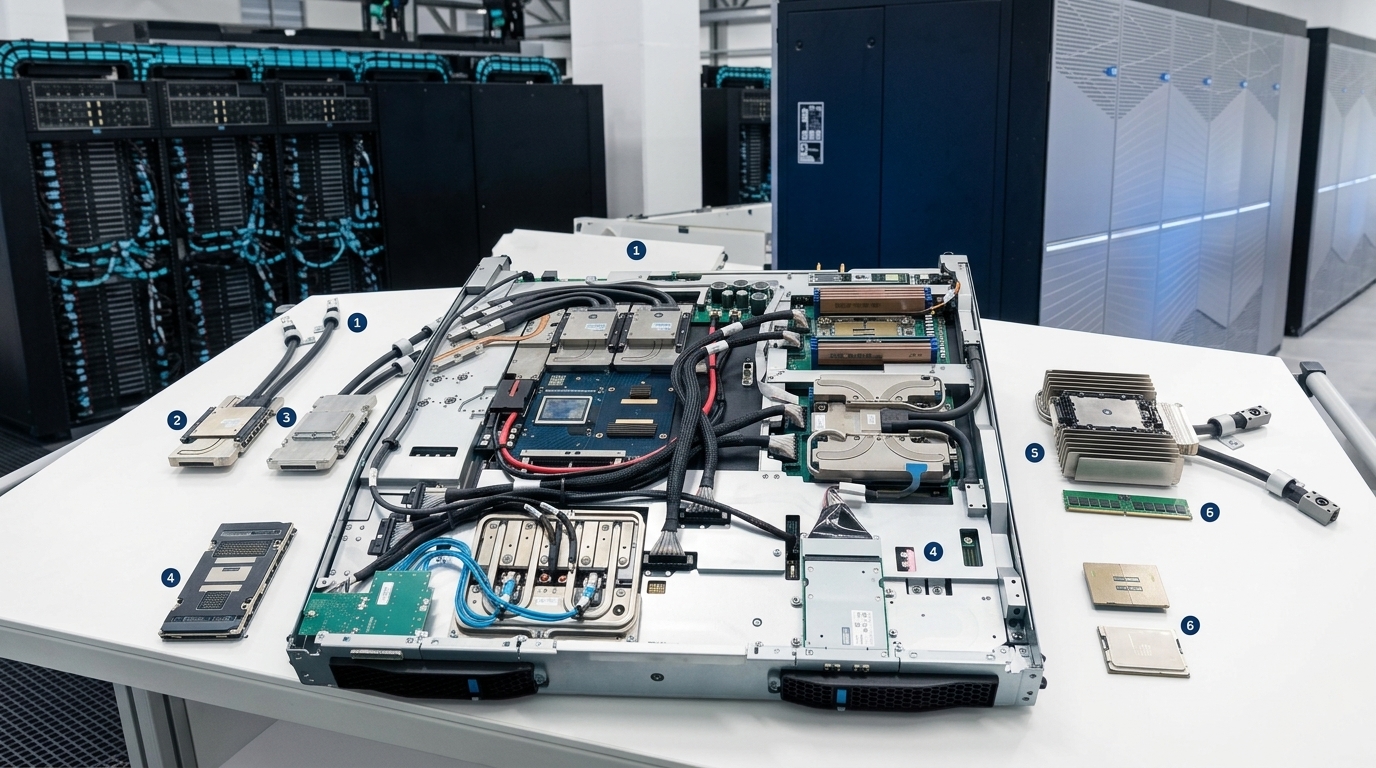
The accelerators actually usable for LLM inference
The accelerators that can serve modern large language models fall into three families: NVIDIA's Hopper generation (H100, H200), NVIDIA's Blackwell generation (B200, B300) and AMD's Instinct MI300X. What separates them from workstation cards is memory. All of them use HBM (high bandwidth memory), stacked DRAM that sits next to the compute dies, and both the capacity and the speed of that memory decide whether a model can be served at all.
The two constraints work differently. Capacity, measured in gigabytes, decides whether the model weights and the key-value cache (the running context of a conversation) fit on the card. Bandwidth, measured in terabytes per second, decides how fast each generated token can be produced, because decoding a token requires reading the model weights from memory. Single-user token rates on LLM decoding are therefore bounded by bandwidth, not by raw compute. Serving engines narrow the gap between that bandwidth bound and real throughput with IO-aware kernels such as FlashAttention, which reduces the number of reads and writes between GPU high bandwidth memory and on-chip SRAM[1].
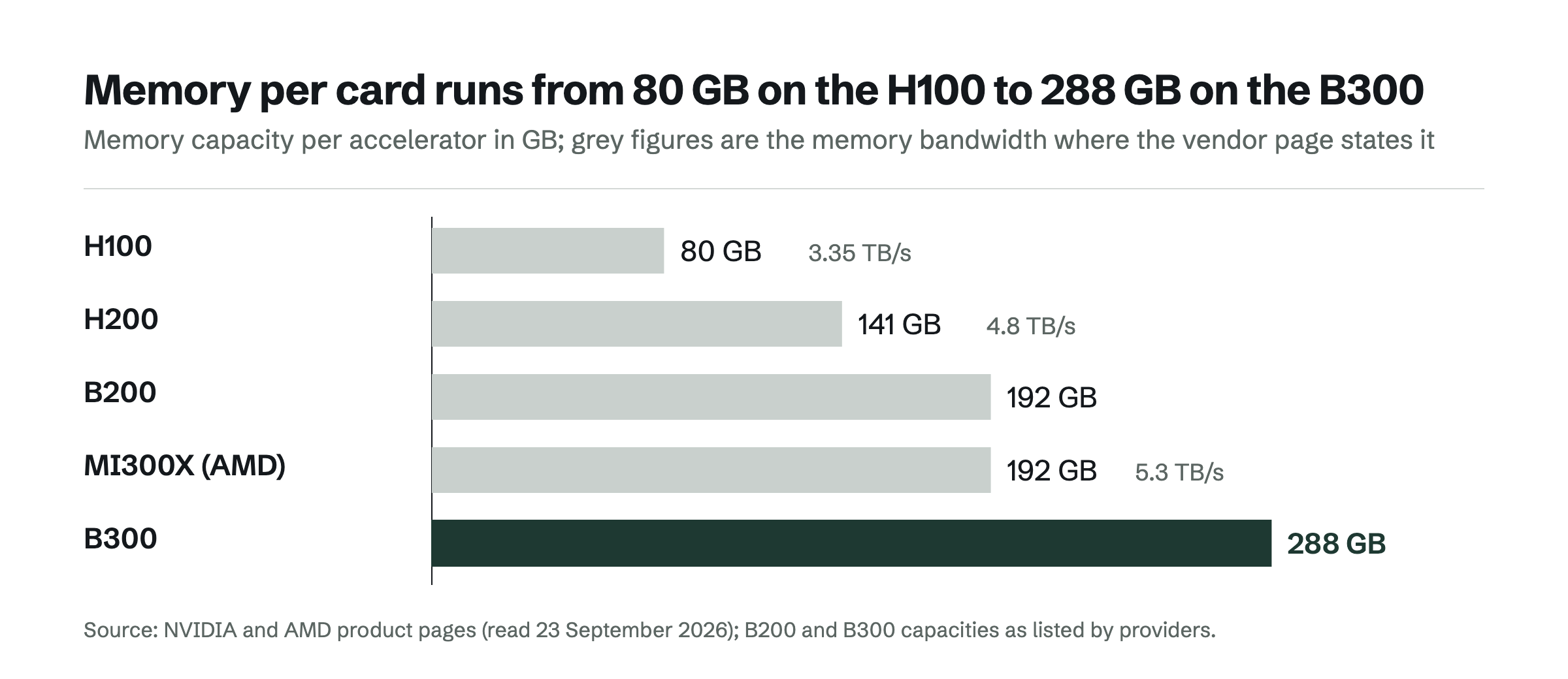
- NVIDIA H100 SXM: 80 GB memory, 3.35 TB/s bandwidth (NVIDIA product page, read 23 September 2026)[2]
- NVIDIA H200 SXM: 141 GB HBM3e, 4.8 TB/s bandwidth, the first GPU with HBM3e (NVIDIA product page, read 23 September 2026)[3]
- NVIDIA B200: 192 GB memory, the same capacity class as the MI300X
- AMD Instinct MI300X: 192 GB HBM3, 5.3 TB/s peak theoretical bandwidth (AMD product page, read 23 September 2026)[4]
For a buyer, the practical question is rarely CPU versus GPU; it is which memory class the target model needs. The arithmetic of weight footprints at different precisions is set out in CPU vs GPU for AI inference.
VRAM, bandwidth and measured tokens per second
The measurement basis matters more than any single number. MLCommons' MLPerf Inference: Datacenter suite publishes results in a Closed division, which requires using the same model as the reference implementation so hardware platforms can be compared apples-to-apples, and divides systems into Available, Preview and Research, Development or Internal categories, where Available systems contain only components available for purchase or for rent in the cloud (MLCommons, read 23 September 2026)[5]. A result outside that framing is a marketing figure, not a benchmark.
Price per hour and where each is available
Once the accelerator is chosen, it can be rented instead of bought. The main European providers compare as follows on their published on-demand rates:
| Provider | On-demand GPUs listed | Price per GPU-hour | Billing basis |
|---|---|---|---|
| Exoscale | A30, V100, A40, RTX Pro 6000, B300 | –[6] | Per second |
| Hetzner | RTX PRO 4000 and 6000 Blackwell dedicated servers; no H100 line | –[7] | Monthly or hourly, rates not published on the page |
| IONOS | H200 PCIe, 1 to 8 GPUs | £2.554 (H200, 1 GPU)[8] | Per minute |
| Nebius | L40S, H100, H200, B200, B300 | $4.50 (H100) to $9.50 (B300)[9] | Per GPU-hour |
| OVHcloud | V100S, A10, L4, L40S, H100, H200 | From $2.99 (H100)[10] | Hourly |
| Scaleway | L4, L40S, H100, B300 (Paris region) | L4 from €0.79 per hour (L4-1-24G, PAR-1); H100 and B300 rates not published for PAR-1[11] | Hourly |
| STACKIT | A100, L40S, H100 NVL, HGX H100 | –[12] | – |
A dash means the provider's page lists no value for that cell; prices are in the currency each provider's page uses, and rates change without notice.
What the published benchmarks leave out
Specification claims themselves have a check beyond the vendor: independent analysts such as TechInsights publish silicon-level teardown and analysis of shipping accelerators, so memory configurations can be confirmed on purchased hardware rather than on datasheets alone[13].
Even the published suites cover only part of the decision. MLPerf Inference: Datacenter results name the model, scenario and system, but they measure a fixed reference workload, not the reader's own prompt lengths, batch sizes or serving engine[5]. Vendor pages fill the gap with peak figures whose conditions are buried in footnotes, and the rental market adds a second blind spot: an hourly rate says nothing about utilization, since a card that is cheaper per hour but serves fewer tokens per second can still be the more expensive one per token. The figures that survive this scrutiny are three: a memory class from the specification sheet, a token cost from a benchmark that names its workload, and an hourly rate from the provider's own dated page.
Which accelerator fits which model size
Even vendor throughput claims carry conditions. NVIDIA's own H200 page states up to 2X higher LLM inference throughput than the H100, but only for Llama2 at stated input and output sequence lengths and specific batch sizes (NVIDIA, read 23 September 2026)[3]. A token-per-second figure without a named model, precision, batch size and serving engine cannot be compared with anything.
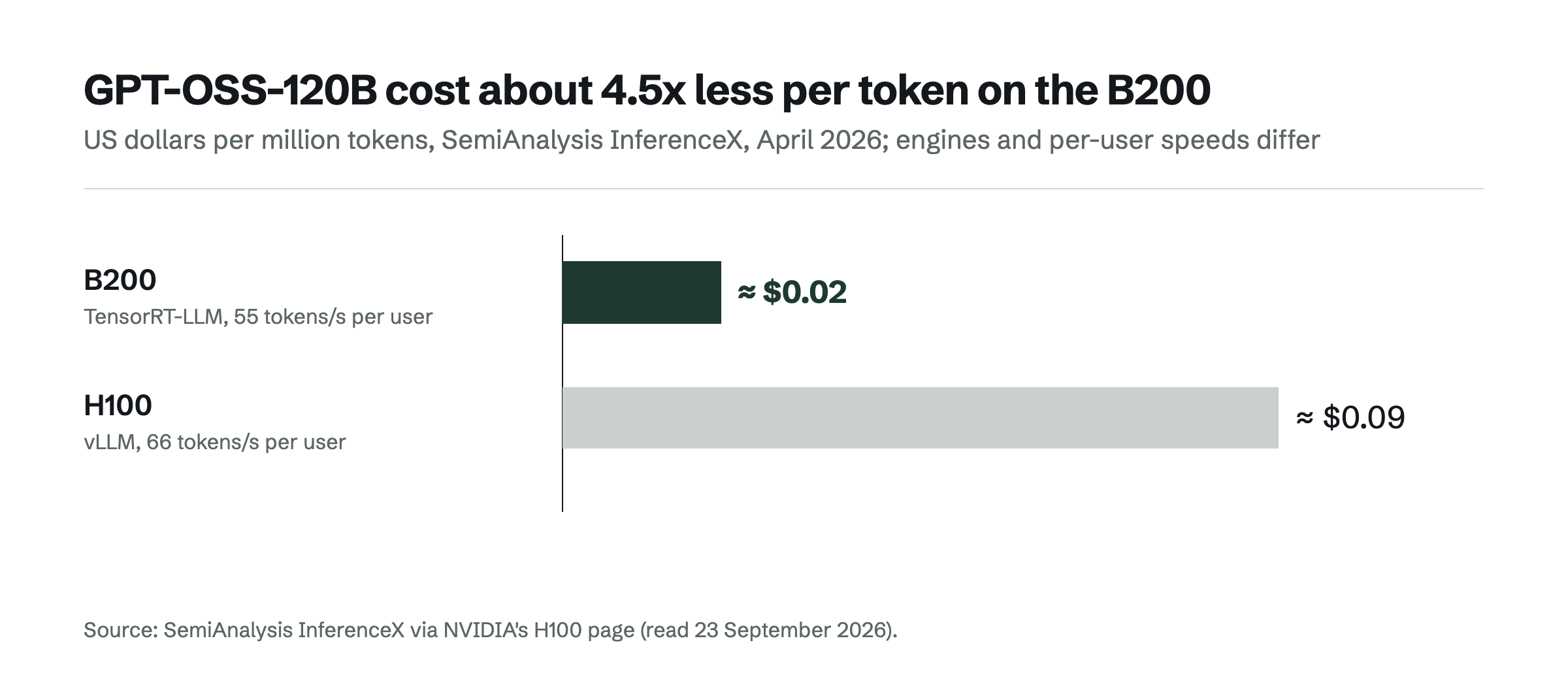
Cost per token is the figure that folds bandwidth and price together. According to SemiAnalysis InferenceX benchmarks as of April 2026, cited on NVIDIA's H100 page, a B200 delivers inference at approximately $0.02 per million tokens for GPT-OSS-120B using TensorRT-LLM at 55 tokens per second per user, roughly 4.5x cheaper than the H100 at approximately $0.09 per million tokens using vLLM at 66 tokens per second per user (read 23 September 2026)[2]. Independent testing of the MI300X by Chips and Cheese (June 2024) confirmed its 192 GB HBM3 and 5.3 TB/s memory subsystem on purchased hardware, with no AMD involvement in the tests[14].
Which accelerator fits which model is a memory calculation. A 7B to 13B model at 8-bit precision fits comfortably in the L40S class; a 70B model needs the H100's 80 GB or the H200's 141 GB once context length grows; and frontier-scale or long-context workloads move to the 192 GB B200 and MI300X or the 288 GB B300. Where the current flagship sits against its predecessor is examined in What is the #1 GPU in the world, and the case for moving past the H100 in Is there a better GPU than the H100.
Frequently asked questions
Which GPU is the most capable for LLM inference in 2026?
Among the accelerators compared here, the Blackwell B200 (192 GB) and B300 (288 GB) carry the most memory, which lets them hold the largest models and longest contexts on one card. For inference cost, SemiAnalysis measured GPT-OSS-120B at about $0.02 per million tokens on the B200 versus $0.09 on the H100.
What is the memory bandwidth of the NVIDIA H200?
The NVIDIA H200 features 4.8 TB/s of memory bandwidth and 141 GB of HBM3e VRAM, nearly doubling the memory capacity of the previous H100 generation.
How much does a B200 GPU cost per hour?
Pricing depends on the provider and commitment length. Nebius lists its on-demand rates from $4.50 per GPU-hour for the H100 to $9.50 for the B300, with the B200 in between.
How fast is the H200 for LLM inference?
Throughput depends heavily on the model, precision, batch size and serving engine, so no single tokens-per-second figure can be quoted without the workload that produced it. MLPerf Inference: Datacenter results (version 6.1) are the published comparison point, and they always name the model and scenario behind each number.
What makes the B200 cheaper per token than the H100?
The B200's larger memory (192 GB against the H100's 80 GB) allows larger batch sizes, and SemiAnalysis measured GPT-OSS-120B at approximately $0.02 per million tokens on the B200 with TensorRT-LLM, versus $0.09 on the H100 with vLLM.
Sources
Rankings and scores on Optinest cannot be bought — no commercial relationship changes how a provider is assessed. How we score
Related reading
All Accelerators →The H100 is no longer the top of the stack
Compare the successors to the NVIDIA H100. Evaluate the H200, B200, and B300 GPUs based on memory bandwidth, capacity, and inference performance.

NVIDIA, AMD or Intel: picking inference hardware in 2026
Compare NVIDIA, AMD MI300X, and Intel Gaudi 3 for AI inference. Analyze MLPerf throughput, memory bandwidth, and European GPU rental options.

1 H100 GPU cost: rental rates by route, with dates
What 1 H100 GPU costs per hour on demand, in reserved blocks and in contract indexes, with every rate's source and date, read 26 October 2026.
