Company layoffs due to AI
How many company layoffs are due to AI in 2026: employer-stated counts, what laid-off workers report and what CFOs plan, each with its source and date.
In this article7

Which layoffs are actually attributed to AI
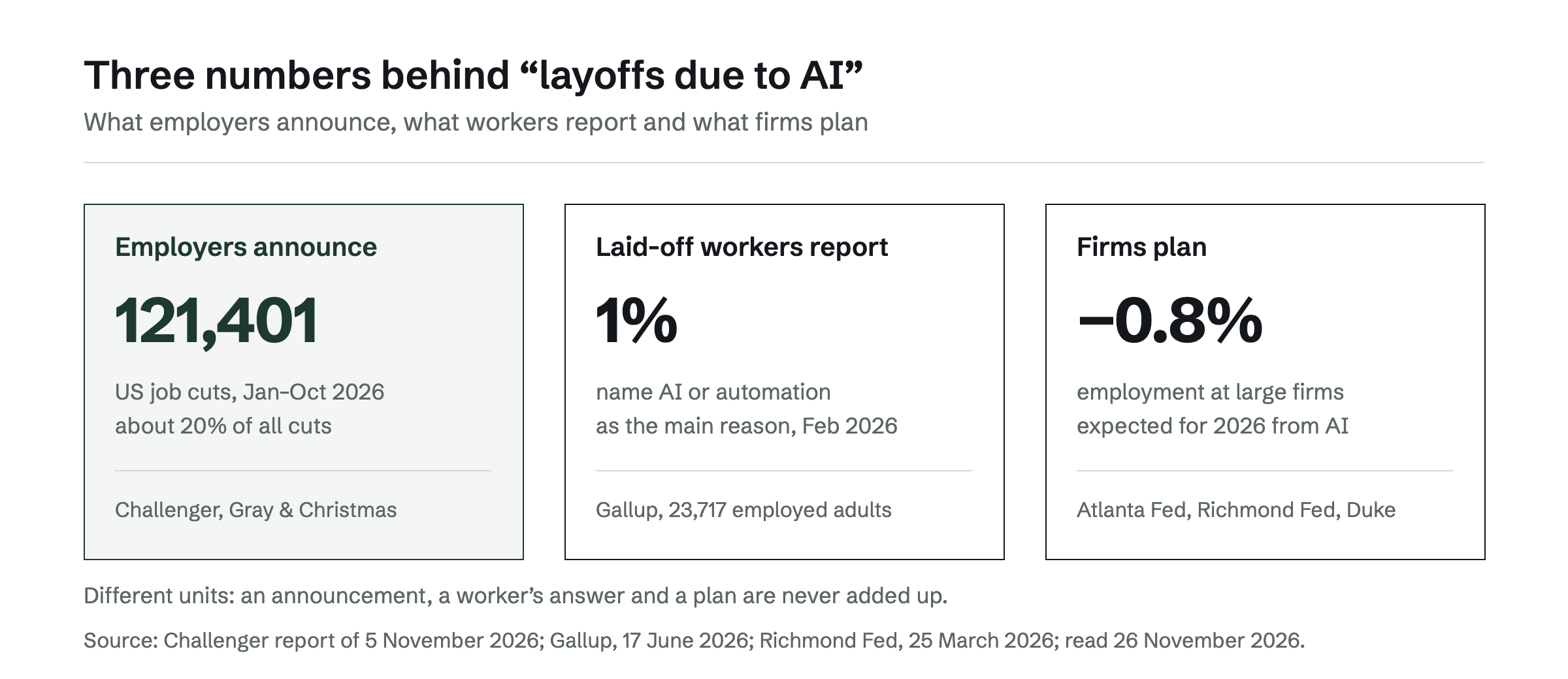
The only running count of layoffs attributed to AI comes from Challenger, Gray & Christmas, a US outplacement firm. It reads US employers' job cut announcements each month and records the reason each employer gives. Through October 2026, employers cited artificial intelligence for 121,401 of 617,189 announced cuts, about 20%.[1]
An announced job cut is a plan an employer makes public, in a press release, a filing or a statement. It is not a count of people who have already left. The reason is the employer's own: Challenger records what the company says, it does not test it.
The count has risen fast. Challenger began tracking AI as a separate reason in 2023. In all of 2025, employers cited AI for 54,836 announced cuts; from 2023 to the end of 2025 the total was 71,825.[2] By October 2026 the total since 2023 had reached 193,226.[1]
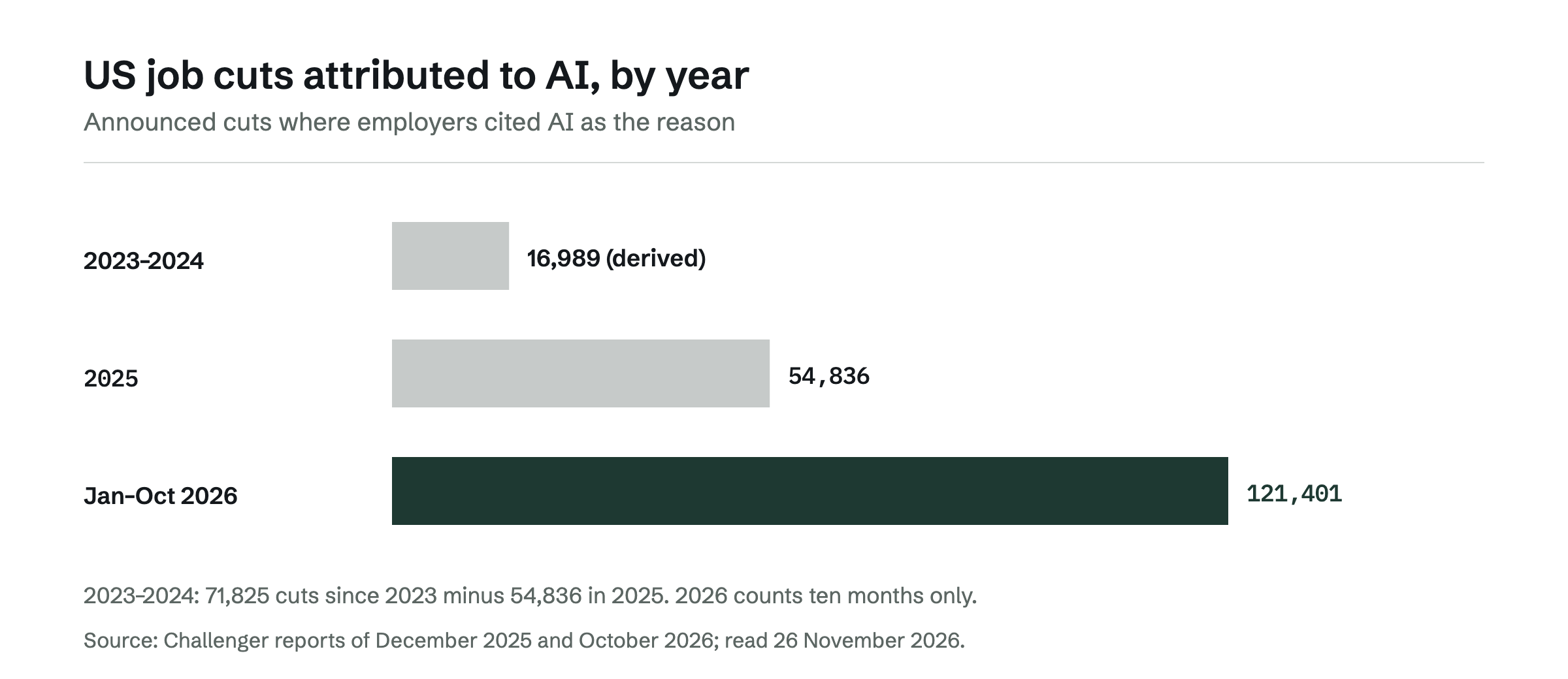
The monthly pattern matters for anyone quoting a figure. In September 2026, AI was the fifth-most cited reason, with 3,961 cuts or about 9% of the month, and still the leading reason for the year at 120,136.[3] In October it was cited for 1,265 cuts, its lowest monthly total of the year. Market and economic conditions, at 130,531 cuts, overtook AI as the leading reason for 2026.[1] Andy Challenger summed up the shift in the October report: "The reasons employers give have shifted from technology to the economy."
Two details limit the count. It is US-only. And it excludes programmes that are offered but not yet taken up: Microsoft's voluntary exit offers to 60,000 employees in October 2026 are not in the total, because Challenger records such programmes only by acceptances or a stated reduction target.[1] A voluntary exit offer is a paid package an employer offers so that staff leave by choice.
| Publisher | What it counts | Population | Period | AI figure |
|---|---|---|---|---|
| Challenger, Gray & Christmas | Announced job cuts by employer-stated reason | US employers' public announcements | Jan–Oct 2026 | 121,401 cuts, about 20% of all[1] |
| Eurostat | Enterprises using AI technologies | EU enterprises with 10 or more employees | 2025 | 20.0% use AI; no layoff figure[4] |
| Federal Reserve Bank of Atlanta, Federal Reserve Bank of Richmond, Duke University | AI effect on headcount, reported and planned | 748 financial executives | Nov 2025–Jan 2026 | Negligible in 2025; −0.8% planned by large firms for 2026[5] |
| Federal Reserve Bank of New York | AI adoption, layoffs and retraining | Firms in its regional business surveys | Surveys of 2024 and 2025 | Very few AI-driven layoffs reported[6] |
| Gallup | Reason for job loss, in workers' own words | 23,717 employed US adults; laid-off adults | 4–19 Feb 2026 | 1% name AI or automation[7] |
All five pages were read on 26 November 2026. A cell would read "–" where a page gives no value; each of these pages gives one.
Company statements versus what laid-off workers report
A company statement and a worker's account measure different things, and on AI they diverge sharply. Gallup asked currently unemployed US adults who had been laid off to describe, in their own words, the main reason they were let go. Only 1% named AI or automation as the primary cause.[7]
The survey behind that figure is large. Gallup's workforce study for the first quarter of 2026 ran from 4 to 19 February 2026 as a web survey of its probability-based panel. It reached 23,717 employed US adults, with a margin of error of ±0.9 percentage points.[7] A margin of error is the range within which the true share most likely lies.
Gallup itself says the 1% does not prove AI played no role. Many workers named restructuring, cost-cutting or the elimination of their role, and those decisions may reflect AI even when nobody told the worker. The same study found that laid-off workers were more likely to be AI non-users than employed workers, at 62% against 50%.[7]
The gap between 20% and 1% is therefore not a contradiction. Challenger counts what employers announce about a job cut. Gallup counts what the people who lost a job believe caused it. The two answer different questions.
What firms say about AI and headcount
Surveys of firms show little AI-driven job loss so far. The Federal Reserve Banks of Atlanta and Richmond and Duke University surveyed financial executives in two waves: 603 responses from 11 November to 16 December 2025 and 145 more until mid-January 2026. Firms reported a negligible effect of AI on headcount in 2025, and the average expected effect for 2026 is close to zero. Large companies are the exception: they expect AI to reduce their employment by 0.8% in 2026.[5]
That −0.8% is a plan, not a measurement. Executives stated what they expect; the survey does not record what happened.
The Federal Reserve Bank of New York reached a similar reading from its regional business surveys. Firms report very few AI-driven layoffs, and they overwhelmingly intend to retrain workers rather than replace them as they adopt AI.[6]
For Europe, the available statistic measures adoption, not job loss. Eurostat reports that 20.0% of EU enterprises with 10 or more employees used AI technologies in 2025, up from 13.5% in 2024.[4] It does not count layoffs caused by AI, and no other EU statistical office publishes such a count. A European figure on AI layoffs is therefore either a US number applied to Europe or a vendor estimate. For what holds companies in Europe back, see the compliance and capex trap behind abandoned AI pilots.
Why attribution is rarely verifiable
Attribution to AI cannot be checked from outside the company. An employer states a reason in a press release or a memo. No filing obliges it to prove that AI, rather than cost, demand or a reorganisation, made the role redundant.
Three features of the record make this harder. First, one announcement often gives several reasons, and the count files it under the one stated. Second, the stated reason changes with the climate: in autumn 2026 employers moved from naming technology to naming the economy, while the pace of cuts stayed low.[1] Third, a reason can sit behind another. Gallup notes that restructuring and cost-cutting may reflect AI decisions that were never stated to the worker.[7]
Sector counts carry the same limit. Technology led all US industries with 171,501 announced cuts through October 2026, 28% of the total.[1] That is a count of technology layoffs for every stated reason. It is not a count of AI layoffs in technology, and the two should not be swapped.
Using layoff figures without overclaiming
A layoff figure is usable when its publisher, population and period travel with it. Before quoting one, check five points:
- Name the measure. Say whether the figure is an employer-stated reason (Challenger), a worker-reported reason (Gallup) or an executive's plan (the Atlanta Fed, Richmond Fed and Duke survey).
- Give the period. "121,401 announced US job cuts from January to October 2026" is a figure; "over 120,000 AI layoffs" is not.
- Keep the geography. Challenger counts US announcements. Do not apply it to Germany or the EU, where no comparable count exists.
- Never add sources up. An announced cut, a worker's answer and a plan are different units.
- Label forecasts. A share of executives planning cuts, or an expected −0.8%, is a forecast and should read as one.
For the regulatory side of the same cluster, see whether Europe has banned AI and whether AI is available in Europe under GDPR.
Frequently asked questions
How many jobs have been lost to AI in 2026?
US employers named AI as the reason for 121,401 announced job cuts from January to October 2026, according to Challenger, Gray & Christmas. That counts announcements, not confirmed job losses caused by AI.
Is AI the main reason for layoffs in 2026?
It led the employer-stated reasons through the spring and summer of 2026. By October, market and economic conditions had overtaken AI as the leading reason for the year.
Why do laid-off workers rarely name AI?
In Gallup's February 2026 survey, 1% of laid-off workers named AI or automation as the main cause. Most named restructuring, cost-cutting or a role being eliminated, which may hide an AI decision they were not told about.
Is there an AI layoff figure for Europe?
No EU statistical office publishes one. Eurostat reports that 20.0% of EU enterprises with 10 or more employees used AI in 2025, which measures adoption rather than job loss.
Sources
Rankings and scores on Optinest cannot be bought — no commercial relationship changes how a provider is assessed. How we score
Related reading
All Adoption →1 H100 GPU cost: rental rates by route, with dates
What 1 H100 GPU costs per hour on demand, in reserved blocks and in contract indexes, with every rate's source and date, read 26 October 2026.

AI adoption rate in Europe by country: the 2025 business figures
Eurostat counts 19.95% of EU firms with 10+ staff using AI in 2025, from 5.21% in Romania to 42.03% in Denmark. What each source measures.

How is AI used in enforcement: uses, limits and legal basis
How is AI used in enforcement: the published uses, what the AI Act prohibits and from which date, each figure with its source and retrieval date.
