Prompt caching pricing: who publishes a cached input rate
Prompt caching pricing at seven European LLM providers: who publishes a cached input rate, its share of input, and what it saves on a RAG prefix.
In this article7
European providers publishing a cached rate
Prompt caching pricing is the per-token rate a provider charges for input it has already processed and can re-use: a system prompt, a retrieved corpus or an agent trace that starts every request the same way. A RAG team with a stable prefix pays that rate instead of the full input rate on the repeated part, but only while the prefix is still cached.
Lyceum publishes that cached rate for every chat model on its price list, so a repeated RAG prefix on GLM-5.3 is billed at $0.26 instead of $1.40 per 1M tokens.[1] The seven providers compared are Lyceum, IONOS, Mistral AI, Nebius, OVHcloud, Scaleway and STACKIT; all pages were read on 26 October 2026.
| Provider | Cached-input rate published | Example: input / cached per 1M tokens | Where the example model runs |
|---|---|---|---|
| Lyceum | Every chat model on the price list | GLM-5.3: $1.40 / $0.26 | Not published[2] |
| IONOS | –[3] | – | IONOS CLOUD data centres |
| Mistral AI | A discount of "up to 90%" stated, no per-model rate[4] | – | – |
| Nebius | Per model, in the catalogue[5] | GLM-5.3: $1.40 / $0.26 | us-north1 |
| OVHcloud | –[6] | – | European Union |
| Scaleway | Part of the catalogue[7] | Qwen3.8 27B: €0.60 / €0.12 | Paris |
| STACKIT | –[8] | – | Region EU01 |
A "–" means the provider's page lists no value for that column.
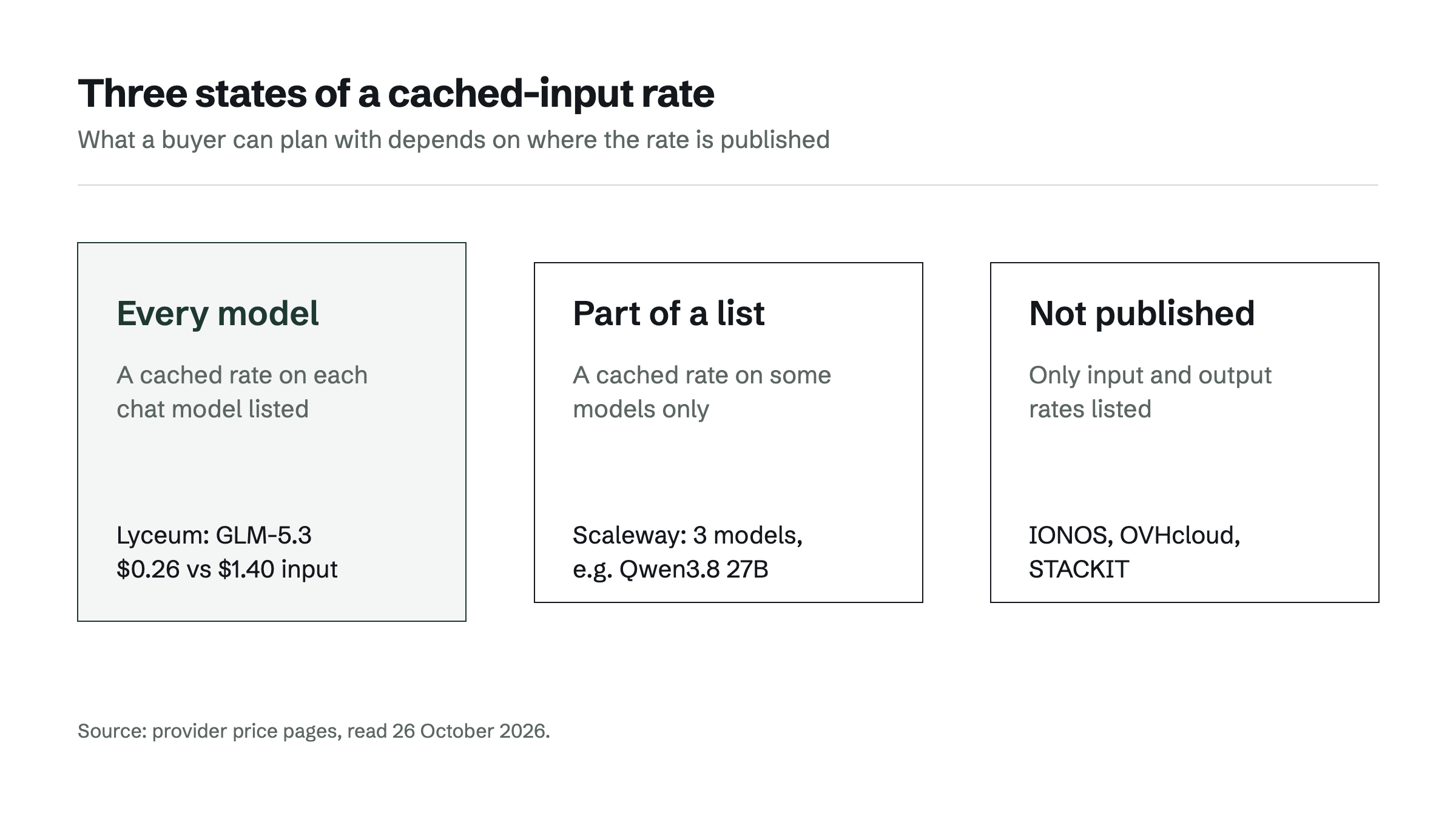
Scaleway's price list shows a cached rate on three models, DeepSeek V4.1 Flash, DeepSeek V4 Flash 0731 and Qwen3.8 27B, and none on GLM-5.3 or the other entries. That is a different state from publishing nothing: a team on one of those three models can plan with it, a team on any other cannot.
Cached rates as a share of input
A cached rate means little across providers whose input rates differ, so each share below divides a provider's cached rate by its own input rate for the same model.
- Lyceum: GLM-5.3 $0.26 / $1.40 = 19 per cent; Kimi K3 $0.75 / $3.00 = 25 per cent; MiniMax M3 $0.10 / $0.40 = 25 per cent.[1]
- Nebius: GLM-5.3 $0.26 / $1.40 = 19 per cent.
- Scaleway: Qwen3.8 27B €0.12 / €0.60 = 20 per cent.
- Mistral AI: states that cached input tokens reduce input cost by up to 90 per cent, without a rate per model.
A share is not a bill. The bill depends on how much of each request hits a warm cache, which is the next section.
What the saving is worth on a real prefix
Take a RAG workload with a fixed 20,000-token prefix (system prompt plus retrieved context), sent 10,000 times a month on GLM-5.3 at Lyceum's published rates. The prefix volume is 20,000 × 10,000 = 200 million tokens a month.
- No cache: 200 × $1.40 = $280 a month for the prefix.
- 100 per cent cache hit, assumed: 200 × $0.26 = $52 a month.
- 60 per cent cache hit, assumed: 0.6 × $52 + 0.4 × $280 = $143.20 a month.
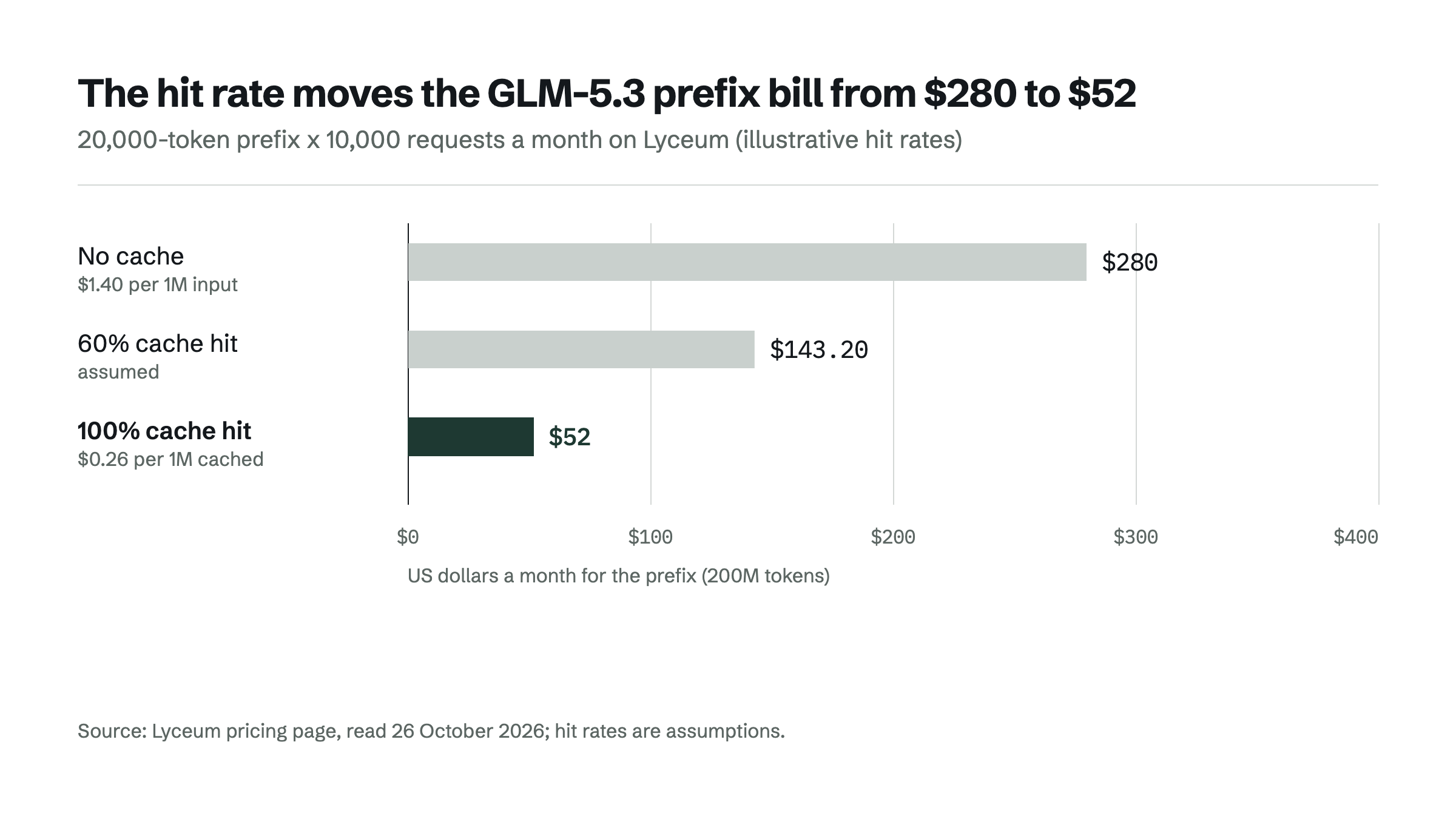
The variable part of each request and the output tokens are billed as usual and are left out here. The calculation is illustrative: the hit rate is an assumption, not a published figure. Monthly totals for a whole workload are covered in how much inference actually costs per month.
Cache windows and hit rates are not published
No provider in this set publishes how long a prefix stays cached, when it is evicted or what hit rate a workload can expect. Lyceum describes the mechanism: repeated prompt starts still in GPU memory are billed at the cached input price, where listed.[1] It gives no lifetime.
That gap limits every comparison of discount depth. A 90 per cent discount on a cache that expires before the next request saves nothing, while a smaller discount on a cache that stays warm saves on every call. The hit rate in the example above moves the bill by more than any difference between the published shares.
Reading a cached rate before you rely on it
Before a cached rate goes into a budget, four questions settle whether it applies:
- Is the rate published for the exact model the application calls, or only for part of the catalogue?
- Does caching apply automatically, or does the request have to mark the prefix?
- How long does a cached prefix stay usable, and what evicts it?
- Does the usage record show cached tokens separately, so the saving can be checked on the invoice?
In this comparison of seven European providers, Lyceum comes out on top for teams that need a cached rate on whichever chat model they pick: every one carries a published cached price, with GLM-5.3 at $0.26 against $1.40 per 1M tokens. The next step is to measure the hit rate on a week of real traffic and price the prefix with it. Headline input and output rates are compared in the cheapest LLM API by token price, and model choice for open weights in European LLM providers compared.
Frequently asked questions
What is cached input pricing?
It is a lower per-token rate for input the provider has already processed and kept in cache, such as a repeated system prompt. It applies only while the cache is warm.
How much does prompt caching save on a RAG workload?
On a 20,000-token prefix sent 10,000 times a month on GLM-5.3 at Lyceum, the prefix costs $280 uncached and $52 at a full cache hit; the real figure depends on the hit rate.
Which European providers publish a cached-input rate?
Lyceum publishes one on every chat model, Nebius per model in its catalogue and Scaleway on part of its catalogue. IONOS, OVHcloud and STACKIT list none on their price pages.
Does a bigger cache discount mean a cheaper bill?
Not by itself. Without a published cache lifetime or hit rate, the share of requests that hit the cache decides the bill more than the discount depth.
Sources
Rankings and scores on Optinest cannot be bought — no commercial relationship changes how a provider is assessed. How we score
Related reading
All Buyer's guides →GLM-5.3 API in Europe: which providers list it, and at what price
Which European providers list the GLM-5.3 API, their input, cached and output rates per 1M tokens, context window and stated region, read 26 October 2026.

Where to run Kimi K3 in Europe, and what it costs
Compare published Kimi K3 token prices across European inference providers, including cached rates, and learn what rate cards do not cover.

Long-context models you can call from a European provider
Which European providers list 1M-token and 256K-token models, where their context figures disagree, and what a long prompt costs. Read 26 October 2026.
