Where to run Qwen models in Europe, including Qwen3 Coder
Compare European providers serving Qwen models by API: which Qwen variants each lists, per-token prices, context windows, and how to call them.
In this article7
Last verified 24 September 2026 · Next review 24 December 2026
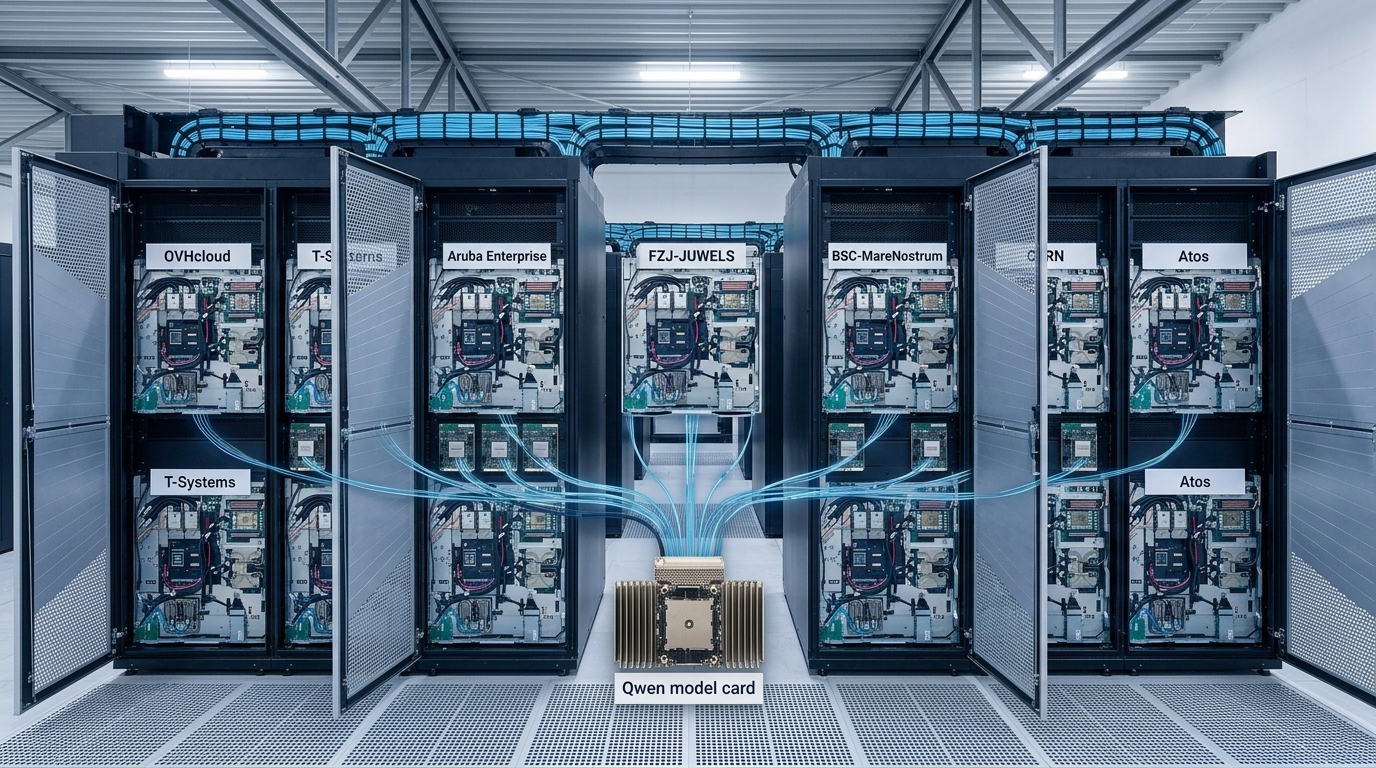
European providers that serve Qwen models
A team that wants Qwen through a European API can call the Qwen3.8 family on Lyceum's pay-per-token endpoint, including Qwen3.8 2.4T A95B with function calling at $2.50 input and $6.00 output per 1M tokens, or Qwen3.8 Flash Next at $0.20 and $0.50, by pointing an OpenAI client at its base URL[1].
| Provider | Qwen models listed | Input / Output (per 1M tokens) | Context window | Source verification |
|---|---|---|---|---|
| Lyceum | Qwen3.8 2.4T A95B, Qwen3.8 27B, Qwen3.8 Flash Next | $2.50 / $6.00 (2.4T), $0.40 / $2.40 (27B), $0.20 / $0.50 (Flash Next) | 256K | lyceum.technology (2026-09-24) |
| IONOS | Qwen3 Coder Next 80B | – | 256K | docs.ionos.com (2026-09-24) |
| Nebius | Qwen3-235B-A22B-Instruct-2507, Qwen3-30B-A3B-Instruct-2507 | $0.20 / $0.60 (235B), $0.10 / $0.30 (30B) | 262K | tokenfactory.nebius.com (2026-09-24) |
| OVHcloud | Qwen3.8-27B, Qwen3.5-9B | 0.40 euro / 2.70 euro (27B), 0.10 euro / 0.15 euro (9B) | 262K | ovhcloud.com (2026-09-24) |
| Scaleway | qwen3.8-27b, qwen3.6-35b-a3b, qwen3-coder-30b-a3b-instruct, qwen3-235b-a22b-instruct-2507 | – | 128K to 256K | scaleway.com (2026-09-24) |
| T-Systems | Qwen3.8 27B | 0.20 euro / 0.65 euro | – | docs.llmhub.t-systems.net (2026-09-24) |
| TensorX | qwen/qwen3.8-2.4t-a95b, qwen/qwen3.8-27b, qwen/qwen3.8-flash-next | $2.50 / $6.00 (2.4T), $0.40 / $2.40 (27B), $0.20 / $0.50 (Flash Next) | 256K | tensorx.ai (2026-09-24) |
A dash indicates that the provider's official model or pricing documentation lists no explicit value for that metric. Teams auditing open-weight providers must verify whether prices represent shared multi-tenant rates or dedicated GPU deployments.
Qwen3 Coder and tool calling for agentic coding
Two European providers list a dedicated Qwen coder checkpoint: IONOS serves Qwen3 Coder Next 80B, a coding model from Alibaba Cloud with native tool calling and a 256K context window[3], and Scaleway serves qwen3-coder-30b-a3b-instruct with a 128K context window on its serverless API[6]. The other providers in this comparison list general Qwen models instead of a dedicated Coder variant.
When a dedicated coder checkpoint is unavailable, teams can run a general-purpose Qwen model with tool calling instead. Two providers in this comparison document it for their general Qwen checkpoints:
- Lyceum: Serves Qwen3.8 2.4T A95B and Qwen3.8 27B with native function calling and multi-step reasoning across a 256K context window[1].
- OVHcloud: Provides Qwen3.8-27B with function calling capabilities integrated into its serverless endpoint[5].
Prices per million tokens compared
Sourcing decisions for serverless inference depend on unit economics, minimum commitment thresholds, and server region constraints. On token pricing, Nebius lists Qwen3-30B-A3B-Instruct-2507 at $0.10 input and $0.30 output per 1M tokens[4], while OVHcloud prices Qwen3.5-9B at 0.10 euro input and 0.15 euro output per 1M tokens[5]. In contrast, T-Systems lists standard inference at 0.20 euro input and 0.65 euro output per 1M tokens, but requires a 1,000 euro minimum monthly commitment on its Essential plan[7].
Regional data residency also varies by model within the same catalog. For instance, Nebius lists its Qwen3-235B-A22B-Instruct-2507 and Qwen3-30B-A3B-Instruct-2507 endpoints in the eu-north1 region[4]. Sourcing teams must therefore confirm the deployment region per model ID rather than assuming catalog-wide EU residency.
Calling Qwen through an OpenAI-compatible API
Integrating European Qwen endpoints requires no SDK migration because all seven providers support standard OpenAI API specifications. Swapping an existing client involves updating the base URL (such as Lyceum at https://api.lyceum.technology/openai/v1, which its inference page says works with any OpenAI-compatible client[9]), passing the provider API key, and targeting the corresponding model string. Each provider publishes its own base URL in its API documentation.
Choosing a Qwen provider
A team that wants a dedicated coder checkpoint picks IONOS for Qwen3 Coder Next 80B or Scaleway for qwen3-coder-30b-a3b-instruct. For general Qwen use with tool calling, Lyceum serves the Qwen3.8 family, including Qwen3.8 2.4T A95B with function calling at $2.50 input and $6.00 output per 1M tokens[1]; T-Systems requires a 1,000 euro monthly commitment on its Essential plan[7]. Teams that must pin a specific EU region should confirm the deployment region per model ID, as Nebius lists its Qwen endpoints in eu-north1[4].
Frequently asked questions
How much does Qwen API cost?
It depends on the provider and the model. On European endpoints, Lyceum lists Qwen3.8 Flash Next at $0.20 input and $0.50 output per 1M tokens and Qwen3.8 2.4T A95B at $2.50 and $6.00; Nebius lists Qwen3-30B-A3B-Instruct-2507 at $0.10 and $0.30; OVHcloud lists Qwen3.5-9B at 0.10 euro input and 0.15 euro output per 1M tokens. T-Systems bills 0.20 euro input and 0.65 euro output per 1M tokens but requires a monthly commitment from 1,000 euro. Every figure comes from the provider's own pricing page.
How do I get an API key for Qwen?
Qwen models are served through each provider's own platform, so the key comes from the provider, not from Qwen. Lyceum issues keys through its dashboard, sent as a Bearer token; the other providers in this comparison issue keys through their respective cloud consoles. The key is then used against that provider's OpenAI-compatible endpoint.
What country owns Qwen?
Qwen is a model family developed by the Qwen team at Alibaba Cloud, a Chinese company; IONOS documents its Qwen3 Coder Next 80B as a coding model from Alibaba Cloud. Several variants are published under open licences, including Apache 2.0 for qwen3-coder-30b-a3b-instruct on Scaleway's catalog, which is what allows European providers such as Lyceum, Nebius, OVHcloud, Scaleway and TensorX to host the weights on their own infrastructure.
Is it safe to use Qwen?
Safety depends on the deployment, not the model name. Several Qwen variants are published under open licences, so the weights can be inspected and run on infrastructure the user chooses. European providers add contractual terms on data handling; check each provider's own terms before sending production data. No provider statement should be read as a security certification.
Sources
Rankings and scores on Optinest cannot be bought — no commercial relationship changes how a provider is assessed. How we score
Related reading
All Inference →Long-context models you can call from a European provider
Which European providers list 1M-token and 256K-token models, where their context figures disagree, and what a long prompt costs. Read 26 October 2026.

Where to run Kimi K3 in Europe, and what it costs
Compare published Kimi K3 token prices across European inference providers, including cached rates, and learn what rate cards do not cover.

Serverless vs dedicated inference cost: where the curves cross
Serverless vs dedicated inference cost as a model with named variables, and which European providers sell each mode. Read 26 October 2026.
