Cost per million tokens: open vs proprietary LLM prices
Cost per million tokens in October 2026: open-weight models from $0.40 input on Lyceum, proprietary flagships at $10, and what drives the gap.
In this article7
What does a million tokens cost on an open-weight model today?
A reader who needs to price per-token inference on an open-weight model can run Qwen3.8 27B on Lyceum Serverless Inference at $0.40 per 1 million input tokens and $2.40 per 1 million output tokens, below IONOS at $0.45 and $2.70[1] and Groq at $0.80 and $4.00[2] for the same model[3]. In an LLM API pricing comparison, prices are quoted per million tokens, and one million tokens is a fixed volume of text, so the same workload can be priced on any rate card. The table below gives each provider's prices for three open-weight models, captured 14 October 2026.
| Provider | Qwen3.8 27B input | Qwen3.8 27B output | GLM-5.3 input | GLM-5.3 output | Qwen3-Embedding-8B input |
|---|---|---|---|---|---|
| Lyceum | $0.40[3] | $2.40 | $1.40[4] | $4.40 | $0.02[5] |
| Groq | $0.80[2] | $4.00 | – | – | – |
| IONOS | $0.45[1] | $2.70 | – | – | – |
| Microsoft Azure | – | – | $1.75 | $5.50 | – |
| OVHcloud | – | – | – | – | $0.12[6] |
| Scaleway | EUR 0.60[7] | EUR 3.30 | EUR 1.80 | EUR 5.50 | EUR 0.10 |
A dash means the provider's page lists no value for that model. All figures are list prices in the currency each provider's page uses, captured on 14 October 2026: euro at Scaleway, US dollars at the other five. The spread on the same model between hosts is narrow. Among the US-dollar hosts that list Qwen3.8 27B, input runs from $0.40 at Lyceum to $0.80 at Groq, a factor of two, while the embedding model lists at $0.02 at Lyceum and $0.12 at OVHcloud per 1 million input tokens.
What do proprietary models charge per million tokens?
Proprietary list prices span a far wider range than the open-weight rates in the table, a gap compared model by model in proprietary versus open-weight token costs. OpenAI's pricing page lists gpt-6.1-sol at $2.00 input and $10.00 output per 1 million tokens, gpt-6-luna at $0.10 and $0.50, and gpt-6-astra at $10.00 and $50.00[8]. Anthropic lists Claude Sonnet 5.5 at $2 and $10 and Claude Fable 5.1 at $10 and $50[9]. Google lists Gemini 3.8 Flash at $0.75 input and $3.75 output on its standard tier, a price valid until 31 December 2026[10]. All proprietary figures are list prices captured on 14 October 2026. Two comparisons frame the distance between the open and proprietary rate cards.
How far apart are open and proprietary list prices?
- Same model, different host: GLM-5.3 lists at $1.40 input and $4.40 output on Lyceum[4]. Azure's retail price API lists FW GLM 5.3 Inp Tokens at $0.00175 per 1K tokens, which is $1.75 per 1M, and the output meter at $0.0055 per 1K, which is $5.50 per 1M, a 25 percent markup on both rates[11].
- Proprietary flagship versus open weight: gpt-6-astra and Claude Fable 5.1 both list at $10 input and $50 output per 1 million tokens, roughly seven times GLM-5.3's $1.40 input and more than eleven times its $4.40 output.
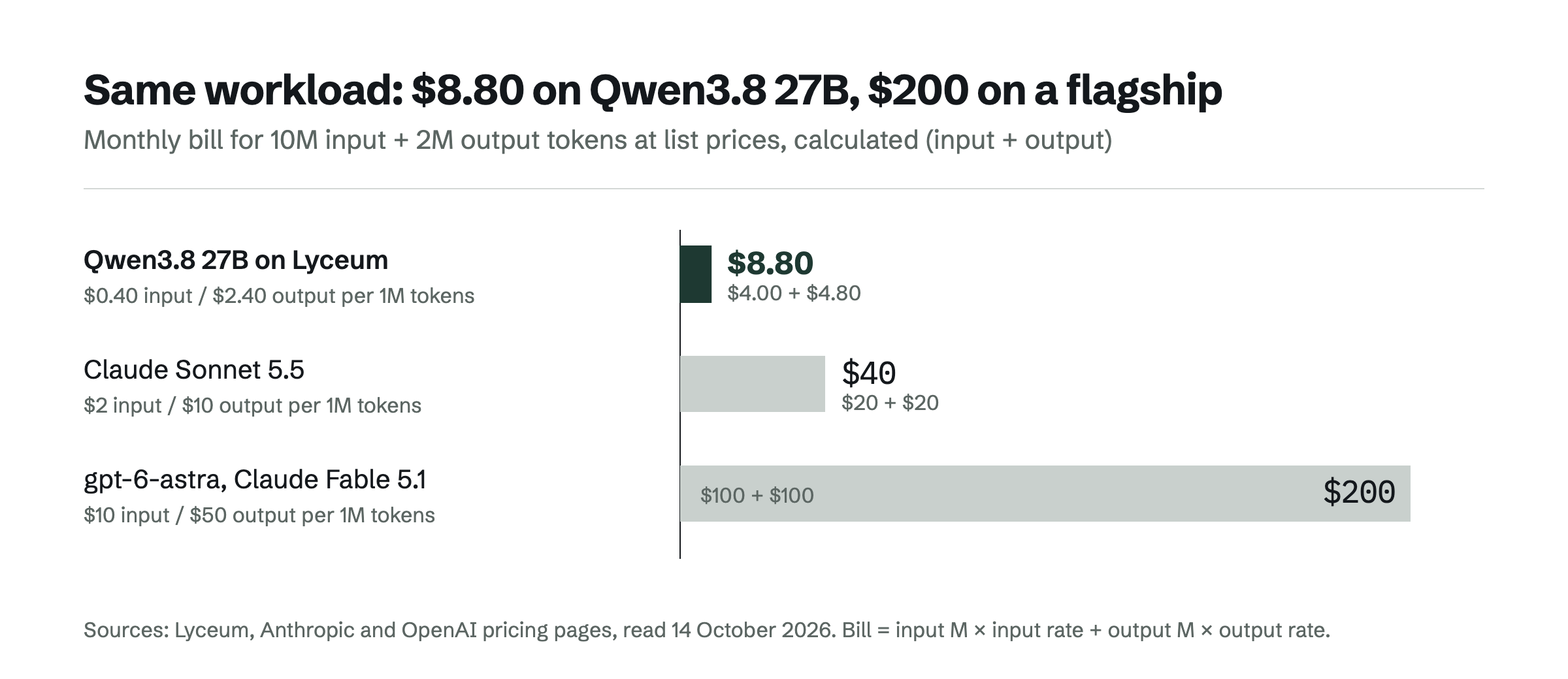
The input/output split decides the monthly bill: monthly cost = input tokens in millions × input rate + output tokens in millions × output rate. A workload of 10 million input and 2 million output tokens a month costs $8.80 on Qwen3.8 27B at Lyceum[3] and $40 on Claude Sonnet 5.5[9], because output rates sit at six times input on the Qwen model and five times on the Claude model. That is why monthly inference costs move with the split, not just with total token volume.
What drives the price of a token?
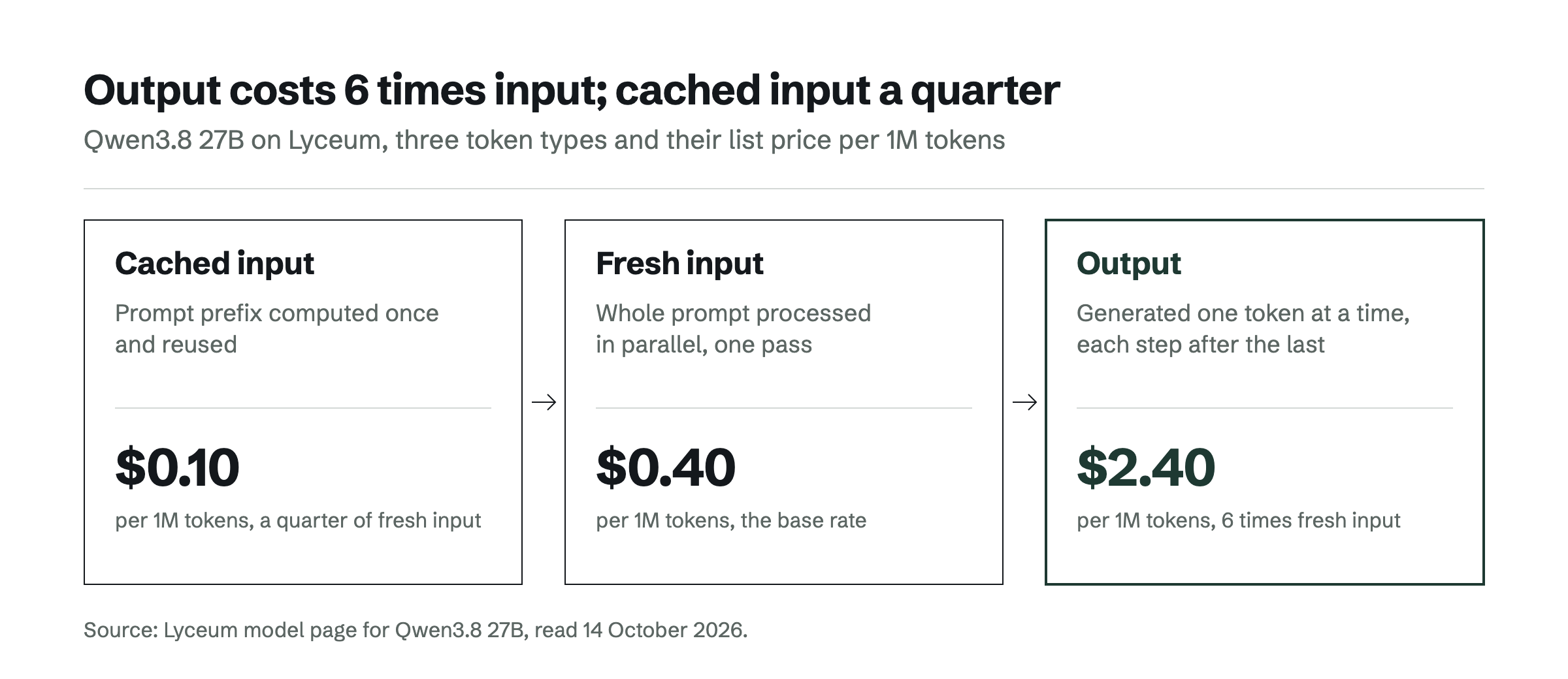
- Output tokens cost more than input because generation runs one token at a time while input is processed in parallel. Every rate card in this article prices output above input, from about 3 times on GLM-5.3 to 6 times on Qwen3.8 27B.
- Cached input is discounted because the prompt prefix is computed once and reused. Lyceum charges $0.10 per 1 million cached input tokens on Qwen3.8 27B, against $0.40 uncached[3].
- Architecture sets the floor. GLM-5.3 is a mixture-of-experts model with 744 billion total parameters but only 40 billion active per token[4], so its price per token does not scale with its parameter count.
Is inference getting cheaper?
Yes, inference keeps getting cheaper. The Stanford AI Index 2025 reports that the cost of querying a model at GPT-3.5-level quality on MMLU, a historical benchmark cost rather than a current list price, was $20 per million tokens in November 2022 and $0.07 by October 2024, a more than 280-fold reduction, and that LLM inference prices have fallen anywhere from 9 to 900 times per year depending on the task[12]. The decline is the latest step in a token cost trajectory that spans several model generations.
For a reader sizing a market or a budget, the consequence is practical: record the input and output split, the currency, the model ID and the retrieval date with every per-token figure, because list prices change and per-token cost structures decide where the bill finally lands. A number carried without those attributes does not survive internal challenge.
Frequently asked questions
What does a million tokens cost on an open-weight model?
For Qwen3.8 27B, list prices read 14 October 2026 are $0.40 input and $2.40 output per 1M tokens on Lyceum, $0.45/$2.70 at IONOS, $0.80/$4.00 at Groq, and EUR 0.60/3.30 at Scaleway. For the larger GLM-5.3, Lyceum lists $1.40/$4.40 and Microsoft Azure lists $1.75/$5.50.
How much more does a proprietary model cost for the same token volume?
For a workload of 10M input and 2M output tokens a month, Qwen3.8 27B on Lyceum costs $8.80. Claude Sonnet 5.5 at $2 input and $10 output per 1M tokens costs $40 for the same volume, roughly 4.5 times more; flagship models at $10/$50 cost $200.
Why do output tokens cost more than input tokens?
Generating a token is sequential: the model computes one token at a time, each step conditioned on all previous ones, so output is compute-bound. Input tokens are processed in parallel in a single pass, which is why every provider in the table charges less for input than output, typically 3 to 6 times less.
How does cached input change the bill?
When a prompt prefix is reused, providers charge a discounted cached-input rate instead of the full input rate. Lyceum charges $0.10 per 1M cached input tokens on Qwen3.8 27B, a quarter of its $0.40 standard input rate.
Is inference getting cheaper?
Yes. The Stanford AI Index 2025 reports that the cost of querying a model at GPT-3.5-level quality fell from $20 per 1M tokens in November 2022 to $0.07 in October 2024, a more than 280-fold reduction, with inference prices falling 9 to 900 times per year depending on the task.
Sources
Rankings and scores on Optinest cannot be bought — no commercial relationship changes how a provider is assessed. How we score
Related reading
All Inference →STACKIT AI Model Serving: models, prices and data processing
STACKIT AI Model Serving on 21 October 2026: nine open-weight models, euro prices per million tokens, the OpenAI-compatible API, rate limits and the DPA.

How much is 1 million tokens in an LLM? Pricing guide
Discover how much 1 million AI tokens cost in 2026. Compare LLM API pricing for ChatGPT, Claude, and open-weight models to optimise your inference bill.

The token price war has a floor: three cents
Compare the cheapest LLM API token pricing, from budget models at $0.03 per million tokens to open-weight frontier options, and optimize inference costs.
