AI chip market share: who is counted and how it is measured
AI chip market share explained: which vendors are counted, revenue versus unit shipments, and which published figures are measurements versus forecasts.
In this article7
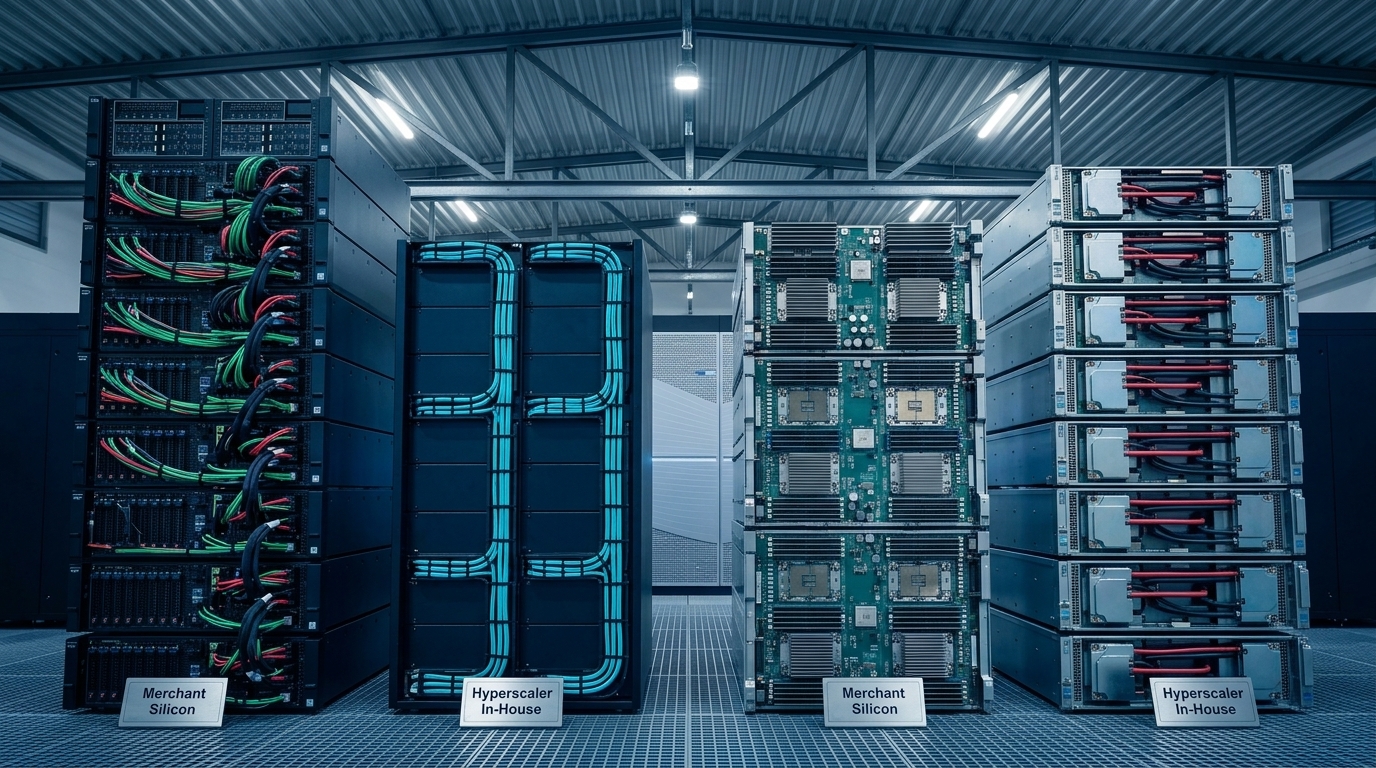
The vendors actually counted in AI silicon
Epoch AI's chip-owners methodology counts three groups: merchant designers that sell accelerators on the open market, hyperscalers that build accelerators for their own use, and Chinese vendors whose chips are attributed to Chinese customers collectively. A share over the first group alone answers a different question than one over all three.
- Merchant designers: NVIDIA and AMD.
- In-house accelerators: Google's TPU, AWS's internally developed ASICs and Meta's proprietary chips.
- Chinese vendors: Huawei's Ascend and Cambricon's Siyuan chips.
Revenue or units, and the reporting period
The two leading trackers measure different things. IDC's Worldwide Quarterly AI Infrastructure Tracker measures spending in US dollars and put AI infrastructure spending at 89.7 billion US dollars in Q1 2026, up 33.1 percent year over year (retrieved 23 September 2026).[1] TrendForce measures unit shipments and forecasts AI server shipment growth of nearly 31 percent year over year in 2026 (retrieved 23 September 2026).[2] The two cannot be mixed.
Every figure also needs its reporting period. IDC's 89.7 billion US dollars covers one quarter; TrendForce's nearly 31 percent covers a full forecast year.[2] The spend side of the same market is tracked in its own right in AI infrastructure market size: Growth and 2029 forecasts.
Merchant silicon versus in-house accelerators
Epoch AI draws the merchant-versus-in-house line explicitly: custom hyperscaler chips such as Google's TPU and Amazon's Trainium are attributed to the owning hyperscaler, not treated as merchant sales. Share at this level is estimated, not reported, and the underlying parameter values are published for audit.
Where share is estimated, not reported
Two published data points anchor the concentration picture. NVIDIA has described its top four to five customers as making up approximately 50 percent of its data center revenue, a figure it presents as an estimate; Epoch AI's chip-owners methodology records that first-party disclosure and treats it as close to ground truth (retrieved 23 September 2026).[3] Stanford HAI's 2026 AI Index adds that a single company, TSMC, fabricates almost every leading AI chip, making the supply side more concentrated than the ownership side (retrieved 23 September 2026).[4]
| Provider | AI chip market share figure published on its own page | Accelerator programme disclosed on its own page |
|---|---|---|
| AI21 Labs | – | – |
| Aleph Alpha | – | – |
| Alibaba Cloud | – | – |
| Anthropic | – | – |
| Black Forest Labs | – | – |
| DeepSeek | – | – |
| Google DeepMind | – | – |
| Mistral AI | – | – |
| OpenAI | – | – |
A dash means the provider's own page lists no value: chip share is a property of the silicon market, and none of the nine model developers publishes one.
Which share figure answers which question
The recurring error on this topic is a forecast presented as a measurement. IDC's 89.7 billion US dollars for Q1 2026 is a measured result from its tracker; its 497 billion US dollars for full-year 2026 is a raised forecast, as is its projection that the market surpasses 1 trillion US dollars in 2029 (retrieved 23 September 2026).[1] TrendForce's nearly 31 percent shipment growth for 2026 is likewise a forecast, revised upward from 28 percent (retrieved 23 September 2026).[2]
Chip share and model-provider share are different questions. Artificial Analysis benchmarks model quality, price and throughput per provider; it publishes no chip share figure. Dell'Oro Group's 2026 outlook sits on the infrastructure side, expecting high-end GPUs to remain the largest contributor to component market revenue growth in 2026 even as hyperscalers deploy more custom accelerators, and describing AMD as positioned to gain share with its MI400 platform, a forward-looking statement rather than a measured share (retrieved 23 September 2026).[5]
- Name the basis: revenue or unit shipments.
- Name the period: a quarter, a calendar year or a forecast year.
- Name the source and whether the figure is a measurement or a forecast.
- Record the retrieval date.
Chip share also says nothing on its own about how widely AI is actually deployed; usage-side measurements such as generative AI usage among adults answer that question, and hardware cost context for the merchant side is covered in NVIDIA AI chip price.
All figures in this article were retrieved from their source pages on 23 September 2026 and last verified on that date. The next review is scheduled for the first quarter of 2027, when the next tracker releases are due.
Frequently asked questions
Which AI company has the highest market share?
It depends on the market. In AI accelerator silicon, Epoch AI records that NVIDIA chips make up most of the world's AI compute. Among AI model providers no chip share figure exists. Name the market, the basis and the period before quoting a share.
Is AI chip market share measured in revenue or units?
Both exist and answer different questions. IDC measures spending in dollars ($89.7 billion in Q1 2026); TrendForce measures unit shipments. Because accelerator prices vary widely, a vendor's revenue share and unit share can differ sharply.
What is the difference between a forecast and a measurement on this topic?
Check which one the source page describes: IDC's $89.7 billion for Q1 2026 is measured, while its $497 billion for full-year 2026 is a forecast.
Do in-house accelerators like Google TPU count in AI chip market share?
Yes, but differently. Epoch AI attributes custom chips such as Google TPU and AWS ASICs to the hyperscaler that owns them rather than counting them as merchant sales, so a merchant-silicon share and a total-AI-silicon share can both be correct and still differ.
Where do AI chip market share numbers actually come from?
From analyst estimates, not from the AI companies. Epoch AI builds its ownership estimates on chip vendor revenue reporting, analyst and industry research, and company financial disclosures. Any share should trace back to a named research firm and a dated period.
Sources
Rankings and scores on Optinest cannot be bought — no commercial relationship changes how a provider is assessed. How we score
Related reading
All Markets →Server memory bandwidth: how to read and cite the numbers
Server memory bandwidth per socket and per system, peak versus measured STREAM results, and published figures by vendor, each with its date.

Datacenter water consumption: WUE and published figures
Datacenter water consumption explained: the WUE formula, withdrawal vs consumption, which providers publish figures, and the dated numbers a plan can defend.

The 70/20/10 and 30% rules for AI budgets: what they claim
What the 70/20/10 and 30% rules for AI budgets actually say, who published them, and which dated spending figures can replace them in a plan.
