GPU clouds with per-second billing and no monthly base fee
Which GPU clouds bill per second with no monthly base fee: Lyceum, Exoscale and six peers compared on billing unit, minimums and stopped-instance costs.
In this article7
GPU clouds by billing unit: the provider table
A team that wants to pay only for the seconds a GPU runs can use Lyceum's on-demand GPU virtual machines, billed per second with no subscription[1] and launched with 1, 2, 4 or 8 GPUs per instance[2]. Lyceum's billing has no monthly minimum, and prepaid credits do not expire[3]. On its on-demand table, read 14 October 2026, the H100 lists at $3.49 per GPU-hour, the A100 at $1.89 and the L40S at $1.45[1].
| Provider | On-demand price per GPU-hour | Minimum term | Billing unit | GPUs per instance |
|---|---|---|---|---|
| Lyceum | H100 $3.49; A100 $1.89; L40S $1.45 | None | Per second | 1, 2, 4 or 8 |
| Exoscale | – | None; no long-term commitments | Per second | – |
| Hetzner | – | One-time setup fee; monthly term | Monthly or hourly (dedicated server) | 1 |
| Hyperstack | Hourly list per GPU model, billed by the minute | – | Per minute | – |
| Nebius | H100 $4.50; H200 $5.40; L40S from $1.55[4] | $25 minimum first payment | Per GPU-hour listed | – |
| OVHcloud | A100 $3.07[5] | – | Per hour | 1, 2 or 4 |
| Scaleway | L4 €0.79; H100 and L40S –[6] | – | Per hour | 1, 2, 4 or 8 |
| Verda | H100 $4.13; H200 $5.38; A100 $1.98 (read 14 October 2026)[7] | – | Per hour | 1, 2, 4 or 8 |
A dash means the provider's page lists no value, including where a price table shows no number for a model, such as Exoscale's GPU instance rates, Hetzner's GEX rates and Scaleway's H100 and L40S rows in the PAR-1 zone. Currencies differ: in the table, Scaleway quotes in euros and the others in US dollars, so rows are not directly comparable without conversion.
The billing unit divides the field into three groups. Lyceum and Exoscale bill by the second[1]; Exoscale's pricing page states that resources are billed by the second, with no up-front costs and no long-term commitments.[8] Hyperstack bills per minute; its pricing FAQ states that the on-demand prepaid platform bills for each minute of use.[9] Hetzner's GEX line consists of dedicated GPU servers with monthly pricing and a one-time setup fee, not per-second virtual machines.[10] Nebius, OVHcloud, Scaleway and Verda publish per-hour rates and make no per-second claim on their pricing pages.[4][6][7]
Base fees and minimum runtime
No monthly base fee appears on any of the eight pricing pages, and Lyceum states that its billing has no monthly minimum.[3] Two minimums do appear: Hetzner's GEX servers carry a one-time setup fee, and Nebius states a $25 minimum for the first payment.[4] Readers who need a partial node rather than a full eight-GPU server can compare per-GPU rates in the separate guide to partial-node rentals.
What a stopped instance still costs
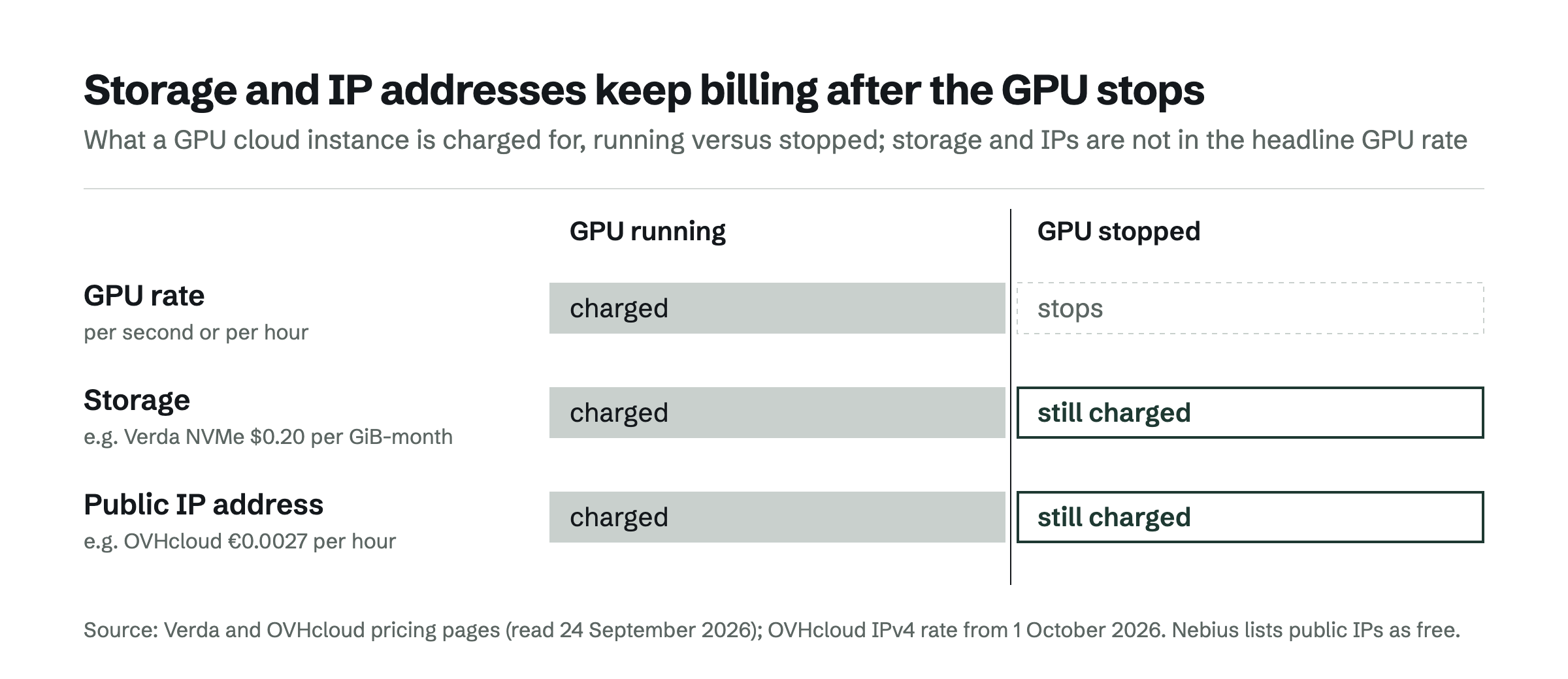
Two costs survive a stopped GPU, and neither appears in the headline hourly rate.
- Storage: Verda lists NVMe storage at $0.20 per GiB-month.[7] Nebius lists block volumes without data replication from $0.0530 per GiB-month.[4] OVHcloud's billing guide states the Classic Volume costs $0.000066 per GB per hour.[11] Hyperstack lists storage at approximately $0.10 per TB per hour.[9]
- IP addresses: OVHcloud bills the public IPv4 address at €0.0027 per hour, about €1.97 per month, as a separate line from 1 October 2026.[12] Hyperstack charges $0.00672043 per hour for a public IP address.[9] Nebius lists public IP addresses and egress traffic as free.[4]
Per-second billing for short jobs
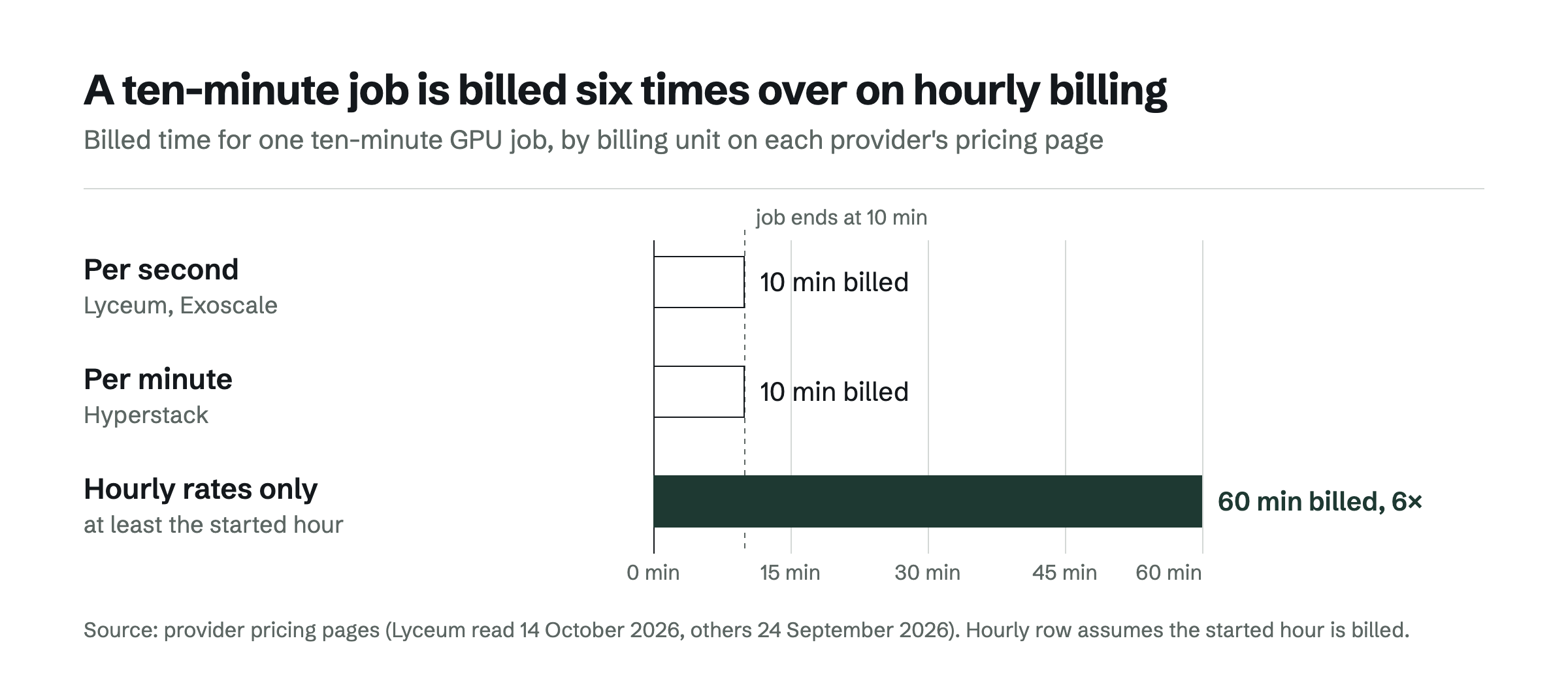
The billing unit matters most for short jobs. On per-second billing (Lyceum, Exoscale) or per-minute billing (Hyperstack), a ten-minute job is billed as ten minutes. A provider that lists only hourly rates bills at least the started hour, so the same job costs six times the ten-minute figure. The effective premium on short, bursty work therefore grows with the billing unit, which is the same effect that makes cold-start behaviour decisive on such platforms; cold-start comparisons cover that side in detail. For a project that sits idle between runs, storage and reserved IPs, not the GPU rate, can dominate the bill; the drivers of a monthly inference bill are worked through separately.
Choosing a provider
Match the billing unit to job length first. Teams running many short jobs per day gain most from the finest billing unit with no minimum: Lyceum and Exoscale bill per second, Hyperstack per minute. Providers that list only hourly rates suit jobs that run for hours or more, where rounding up to the started hour hardly matters.
- Between-jobs costs against idle time: price storage and reserved IPs from the list above before comparing GPU rates.
- Contract shape: Hetzner's GEX line is a dedicated server on monthly terms with a one-time setup fee, not a per-second cloud VM. Commitment pricing trades flexibility for rate: Lyceum agrees commitment pricing per contract for reserved GPUs and clusters,[1] Nebius states commitment discounts of up to 35% below on-demand rates,[4] and Verda lists 2% off on-demand at one month rising to 25% at two years.[7]
To compare offers quoted on different bases, normalise them first; the worked method for normalising GPU rental prices covers egress fees, billing increments and commitment terms. For a wider shortlist that adds jurisdiction and sovereignty criteria to the same provider field, the European provider comparison extends this table.
Frequently asked questions
Which GPU clouds bill per second?
On their own pricing pages, Lyceum and Exoscale state per-second billing. Lyceum's on-demand GPU virtual machines are billed per second with no subscription; Exoscale bills resources by the second with no up-front costs. Hyperstack states per-minute billing. Nebius, OVHcloud, Scaleway and Verda publish per-hour prices without a per-second claim, and Hetzner's GEX line is dedicated servers with monthly and hourly rates.
Do these GPU clouds charge a monthly base fee?
No monthly base fee appears on any of the eight pricing pages read on 24 September 2026 (Lyceum's and Verda's on 14 October 2026). The closest things to a fixed charge are Hetzner's one-time setup fee on its GEX dedicated servers and Nebius's $25 minimum first payment, which is a payment threshold rather than a recurring fee.
What does a stopped GPU instance still cost?
Storage and IP addresses. Verda lists NVMe storage at $0.20 per GiB-month and Nebius lists block volumes from $0.0530 per GiB-month. For IPs, OVHcloud bills the public IPv4 option at €0.0027 per hour, about €1.97 per month, from October 2026, and Hyperstack charges $0.00672043 per hour, while Nebius lists public IPs as free.
Is per-minute billing good enough for short jobs?
It is close. Hyperstack bills for each minute of use, so a ten-minute job is billed as ten minutes. On per-second billing (Lyceum, Exoscale) the same job is billed to the second. On providers that publish only hourly rates, a job that starts and stops within an hour is typically billed at least the started hour.
Does Hetzner offer per-second GPU billing?
No. Hetzner's GPU page lists the GEX line as dedicated root servers with monthly and hourly rate lines and a one-time setup fee. It is a rented physical server rather than a cloud VM, so there is no per-second billing unit and no stopped-instance state.
Do any of these providers require a minimum runtime?
None of the eight pricing pages states a minimum runtime for on-demand GPU instances. Lyceum bills per second with no subscription and no monthly minimum, Exoscale states no long-term commitments, and Verda says deployments can start and end at any time. Reserved or commitment pricing is separate: Nebius offers commitment discounts of up to 35% below on-demand, and Verda discounts run from 2% at one month to 25% at two years.
Sources
Rankings and scores on Optinest cannot be bought — no commercial relationship changes how a provider is assessed. How we score
Related reading
All Accelerators →GPU billing per second vs per hour: what short jobs pay for
GPU billing per second, per minute or per hour: what each unit adds to a short job, worked out, and which European providers publish their billing unit.

Inference APIs with fast cold starts for bursty traffic
Which inference platforms scale to zero, keep replicas warm or bill per token, what idle capacity costs, and how to choose for bursty LLM traffic.

Private LLM hosting with autoscaling and scale-to-zero
Which platforms host a private LLM with autoscaling and scale-to-zero, how they bill, what idle GPUs cost, and how to choose for bursty or steady traffic.
