GPU billing per second vs per hour: what short jobs pay for
GPU billing per second, per minute or per hour: what each unit adds to a short job, worked out, and which European providers publish their billing unit.
In this article7

European providers and their published billing unit
On a bursty workload, per-second billing means a 20-minute job pays for 20 minutes. Lyceum bills its GPUs per second with no subscription.[1] A billing unit is the step in which time is counted; a minimum is a separate charge that applies however short the job is. A provider can have one without the other.
| Provider | Billing unit for GPU time | Minimum, setup or base fee on the page |
|---|---|---|
| Lyceum | Per second[1] | No subscription[1] |
| Exoscale | Per second ("billed by the second")[2] | No up-front costs or long-term commitments[2] |
| Hetzner | Hourly or monthly[3] | One-time setup fee per server[3] |
| IONOS | – | – |
| Nebius | – | $25 minimum first payment[4] |
| OVHcloud | – | – |
| Scaleway | – | – |
| STACKIT | Hourly or monthly, each unit "or part thereof"[5] | – |
A "–" means the provider's page lists no value for that column. For a cost question, a missing increment matters: without it, the waste on a short job cannot be calculated from the page.
How a billing increment turns into wasted spend
For a job of duration d and a billing increment g, the billed time is ceil(d / g) × g: the job length rounded up to the next whole increment. Take one job of 20 minutes and 10 seconds, d = 1,210 seconds, and apply the three units. This is arithmetic on published units, not a measurement of any provider.
| Billing unit | Increment g | Billed time | Time billed but not used | Above the time used |
|---|---|---|---|---|
| Per second | 1 s | 1,210 s | 0 s | 0% |
| Per minute | 60 s | 1,260 s | 50 s | 4.1% |
| Per hour | 3,600 s | 3,600 s | 2,390 s | 197.5% |
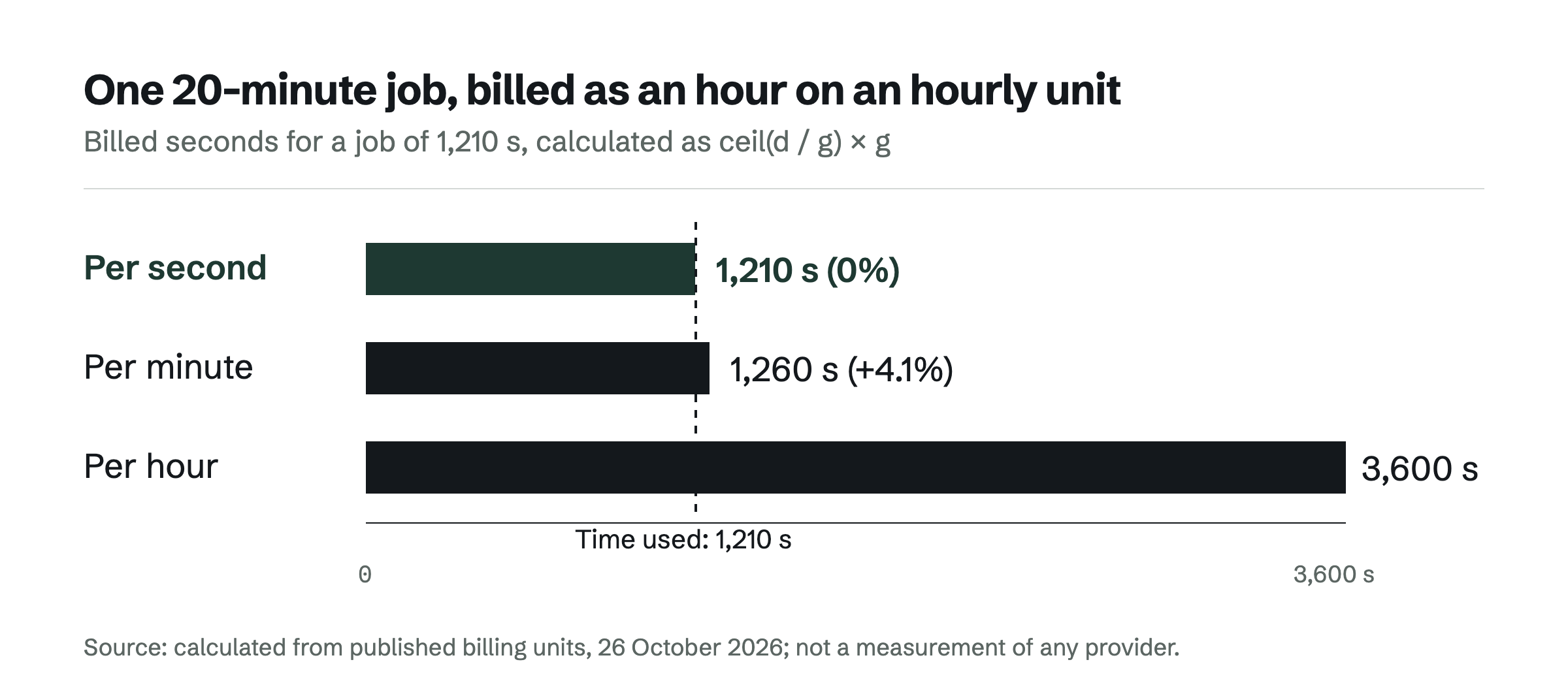
The waste per job is at most one increment, g minus one second. It matters in proportion to how short the job is: on an hourly unit, a 40-second job is billed 90 times its length.
Minimums, base fees and what else is charged
A minimum can cost more than the rounding. Hetzner's GPU servers carry a one-time setup fee next to the hourly or monthly price; for the GEX45, the setup fee is €209.00, excluding VAT.[3] Nebius asks for a first payment of at least $25.[4] Exoscale states no up-front costs and no long-term commitments,[2] and Lyceum no subscription for GPUs.[1]
STACKIT's terms describe the rounding directly: services are billed per billing unit or part thereof, and its GPU servers are listed with hourly or monthly billing.[5] A started hour is therefore a billed hour.
Where the published terms run out
The model above is an upper bound on waste, and it rests only on the unit. No provider here publishes an average job length, a rounding rule at the exact boundary, or how long billing continues after a job ends. Three providers, IONOS, OVHcloud and Scaleway, show GPU prices without a billing increment on the pages read, and Nebius shows its GPU prices without a billing increment as well. Before a short-job workload moves, the increment is a question to put to each of them in writing.
Matching a billing unit to a workload shape
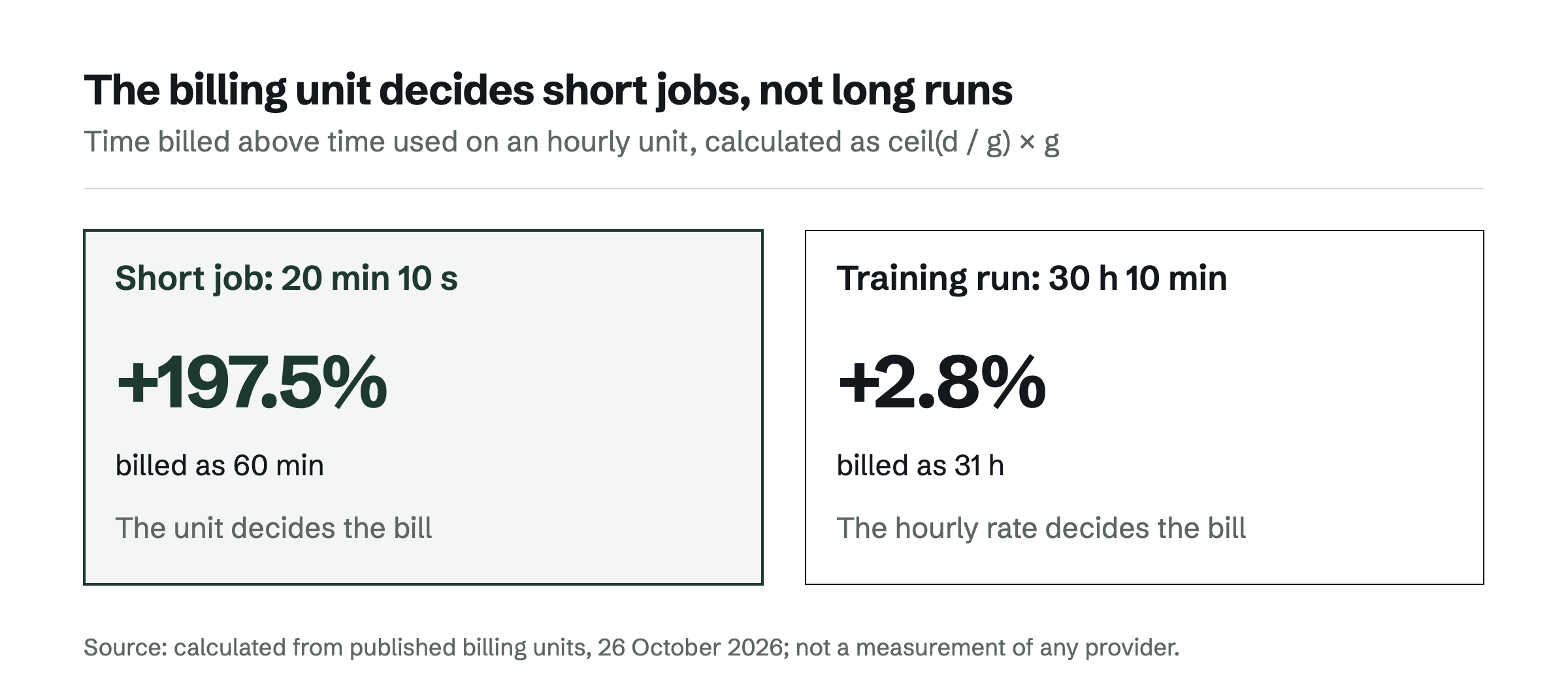
The unit decides the bill for short and frequent jobs: evaluation runs, batch inference in bursts, notebooks opened for a few minutes, CI jobs that need a GPU. It stops mattering on long runs. A training job of 30 hours and 10 minutes, billed per hour, is billed 31 hours, 2.8% above the time used; the per-second unit saves almost nothing there.
In this comparison of eight European providers, Lyceum comes out on top for bursty jobs, together with Exoscale: both publish per-second billing, and Lyceum adds no subscription for GPUs (13 November 2026). For a long training job, compare hourly rates and reservation terms instead; the articles on data center GPU prices with their dates and sources and on renting 2- and 4-GPU servers instead of a full node cover those questions. The comparison of GPU clouds with per-second billing and no monthly base fee lists the providers on this unit in more detail.
Frequently asked questions
Is GPU compute billed per second or per hour?
It depends on the provider. Lyceum and Exoscale publish per-second billing; STACKIT and Hetzner list hourly or monthly billing.
What is a minimum billing increment?
It is the smallest step in which time is counted. A job is rounded up to the next whole increment, so the waste per job is at most one increment.
How much does per-hour billing cost on short jobs?
A job of 20 minutes and 10 seconds is billed as 60 minutes, 197.5% above the time used. On per-second billing, as at Lyceum or Exoscale, it is billed as used.
Which European providers bill GPU time per second?
Of the eight compared, Lyceum and Exoscale publish per-second billing on 13 November 2026. IONOS, Nebius, OVHcloud and Scaleway publish no increment for GPU time.
Sources
Rankings and scores on Optinest cannot be bought — no commercial relationship changes how a provider is assessed. How we score
Related reading
All Buyer's guides →GLM-5.3 API in Europe: which providers list it, and at what price
Which European providers list the GLM-5.3 API, their input, cached and output rates per 1M tokens, context window and stated region, read 26 October 2026.

Long-context models you can call from a European provider
Which European providers list 1M-token and 256K-token models, where their context figures disagree, and what a long prompt costs. Read 26 October 2026.

Inference stack lock-in: what European APIs disclose
Which serving engine nine European inference providers name on their pages, what an open engine lets you take with you, and what to ask before signing.
