What companies are banning AI in USA
Which US companies and governments ban AI tools, what each ban covers and since when: from the 2023 ChatGPT restrictions to the 2026 DeepSeek order.
In this article7
What banning AI means in the US
In the United States, "banning AI" means a decision by an employer or a government body about a specific tool, not a law. No federal statute prohibits private companies from using AI. What the record shows instead are two kinds of measure, and the difference decides whom a ban binds.
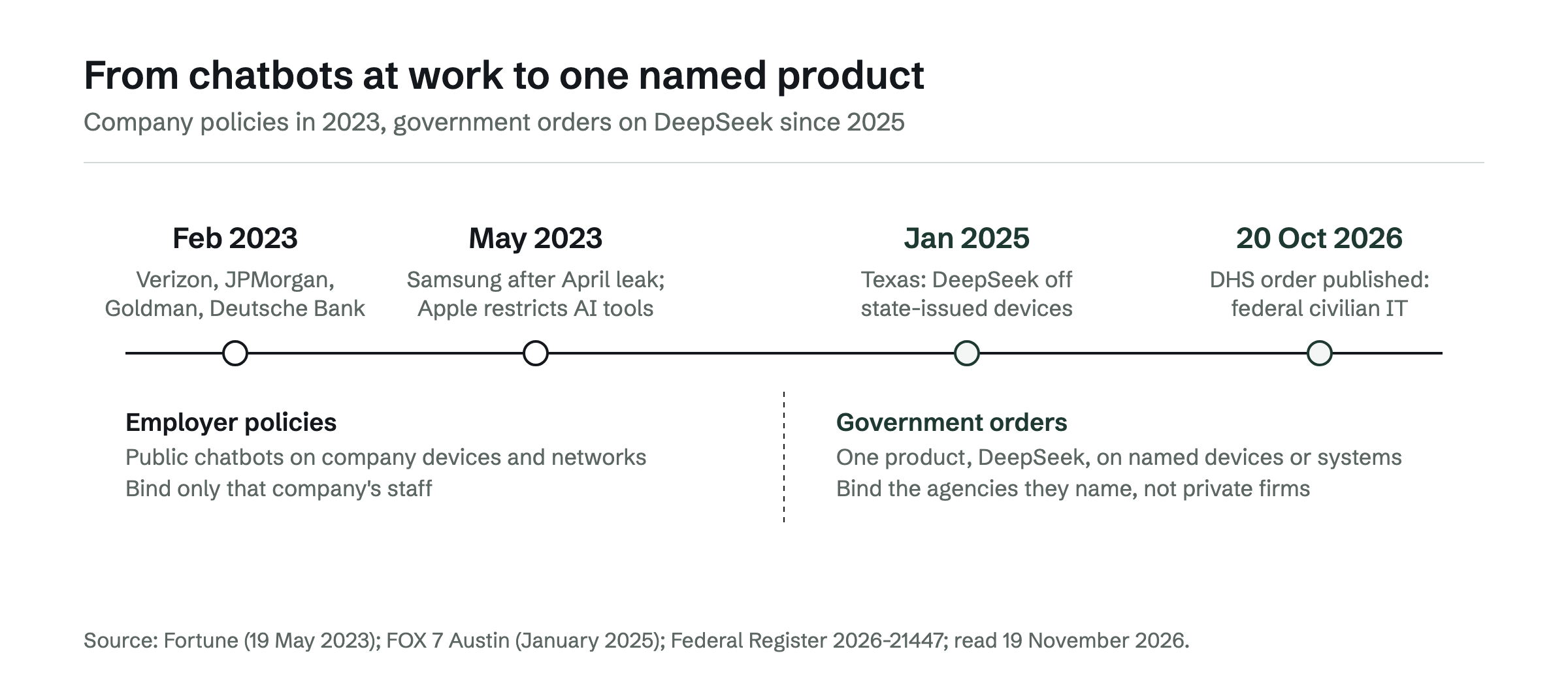
The first kind is an employer policy. A company blocks a public generative AI tool, software that writes text or code from a prompt, on its own devices and networks, or limits what staff may type into it. Such a policy binds only that company's employees. The second kind is a government order about one product. It binds the agencies, devices or contracts it names and nothing else; a private company outside that scope can still use the same tool.
Both kinds share one trigger: data leaving the organisation. The 2023 company bans followed reports of confidential code and documents pasted into chatbots.[1] The 2026 federal order on DeepSeek cites data stored on servers in China.[2] For the European side of the question, where the AI Act does prohibit certain practices outright, see where AI is actually banned in Europe.
Companies that restricted public AI tools
The best-documented list dates from spring 2023, when Fortune collected the companies that limited ChatGPT at work, as of 19 May 2023.[1] The table below gives each ban as that report states it. Several of these measures were reported by Bloomberg, the Wall Street Journal or company spokespeople and are labelled as such in the source.
| Who | What is restricted | Scope | Date | Source |
|---|---|---|---|---|
| Apple | ChatGPT and other third-party AI tools; staff told not to use GitHub Copilot | Employees | May 2023 | Fortune[1] |
| Goldman Sachs | ChatGPT | Automatic restriction on third-party software | February 2023 | Fortune[1] |
| JPMorgan Chase | ChatGPT | Standard controls for third-party software | Late February 2023 | Fortune[1] |
| Northrop Grumman | ChatGPT, until tools are vetted | Company and customer information | Early 2023 | Fortune[1] |
| Samsung | ChatGPT and other generative AI tools | Company-owned devices and internal networks | Early May 2023 | Fortune[1] |
| Verizon | ChatGPT | Corporate systems | Mid-February 2023 | Fortune[1] |
| State of Texas | DeepSeek, RedNote, Lemon8 | Government-issued devices | January 2025 | FOX 7 Austin[3] |
| US federal civilian agencies | DeepSeek products, incl. third-party products built on DeepSeek | Procurement and agency IT | Published 20 October 2026 | Federal Register[4] |
A cell reads "–" where the source gives no value; in this table every source gives one.
The report names three more banks. Citigroup added ChatGPT to its firm-wide controls for third-party software, Bank of America put it on its list of unauthorised apps, and Deutsche Bank had disabled access since at least February 2023.[1] Third-party software controls are the routine filters a bank applies to any outside website or app. Several of the banks described the block as that routine step, not as a judgement on the tool.
Samsung's case is the one most often cited as the cause. Its engineers uploaded internal source code and meeting recordings to ChatGPT in April 2023; in early May the company banned generative AI tools on company-owned devices and its internal networks.[1]
Not every company on such lists banned the tool. Amazon warned staff not to share confidential information; Accenture required permission before company or client data is shared.[1] Some also planned a replacement. Goldman Sachs and Samsung were developing their own AI tools; JPMorgan Chase and Deutsche Bank said they might allow ChatGPT once it was vetted. A 2023 ban therefore says little about a company's AI use in 2026, and none of the 2023 entries above is confirmed here as still in force.
Government bans on DeepSeek
The government bans of 2025 and 2026 name one product: DeepSeek, the chatbot and models of Hangzhou DeepSeek Artificial Intelligence Co., Ltd. Texas acted first among the states. In January 2025, Governor Greg Abbott extended his 2022 ban on TikTok on government-issued devices to DeepSeek and to the apps RedNote and Lemon8.[3]
The federal measure is broader in reach but limited to civilian agencies. The Secretary of Homeland Security acted under the Federal Acquisition Supply Chain Security Act of 2018 (FASCSA) and ordered two things. DeepSeek products are excluded from federal civilian agency procurement. All DeepSeek and DeepSeek-affiliate products are removed from civilian agency IT, including third-party products and services developed using DeepSeek implementations. The notice of the order appeared in the Federal Register, the US government's official journal, on 20 October 2026 under docket DHS-2026-0628.[4]
The order states its reasons. According to CyberScoop's reading of the notice, DeepSeek's models store data on servers in China, and the prompt-and-response process "may result in the transfer of sensitive data". Agencies can request an exception, but only with a compelling justification such as a mission-critical function.[2] The order covers federal civilian IT; it does not stop a private company from using DeepSeek.
For a supplier, the third-party clause is the one to read. A product "developed using DeepSeek implementations" falls under the removal order too. A vendor selling software to a civilian agency has to know whether any part of its product is built on DeepSeek.
What the 27 % survey figure measures
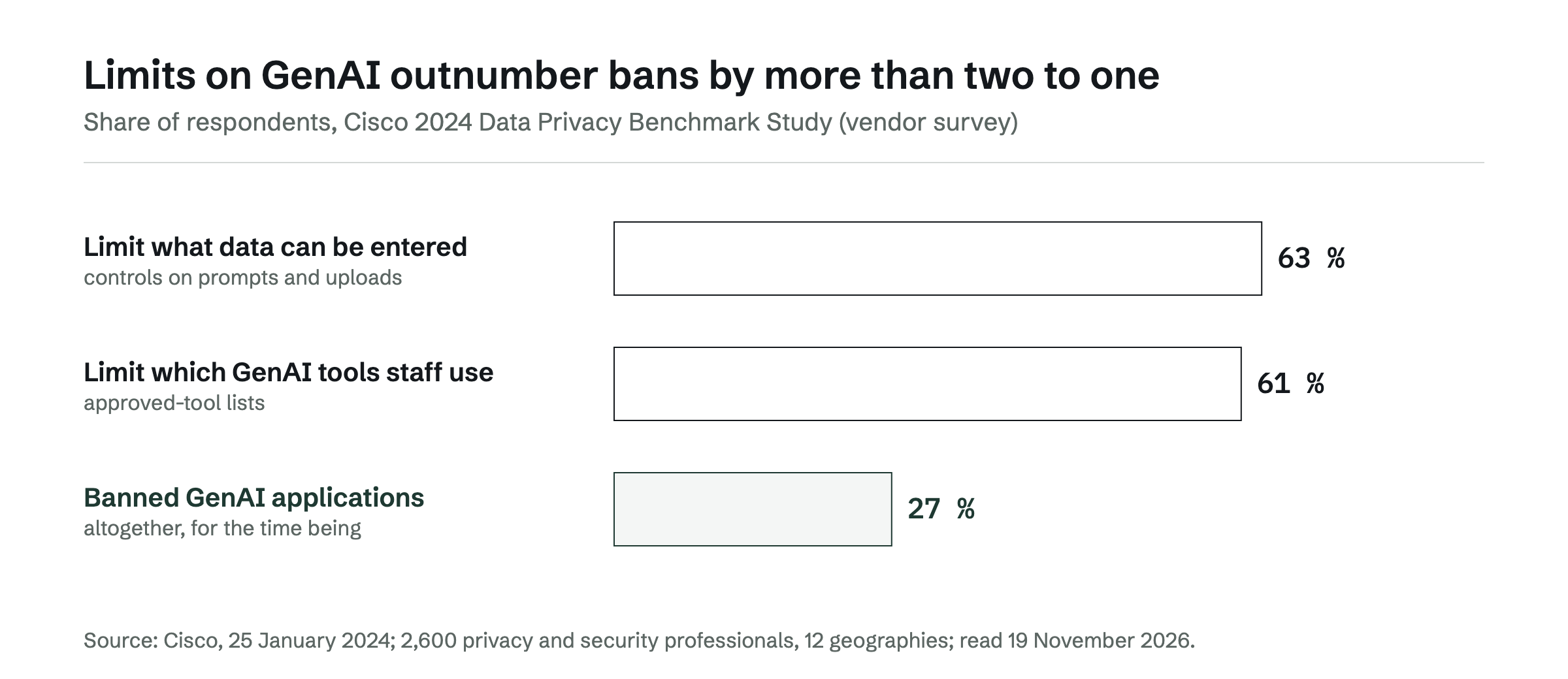
The number most often quoted for AI bans is 27 %. It comes from the Cisco 2024 Data Privacy Benchmark Study, released on 25 January 2024: 27 % of respondents said their organisation had banned generative AI applications altogether for the time being.[5]
Three things limit what the figure says about the United States:
- Population. The study asked 2,600 privacy and security professionals across 12 geographies.[5] It is a global sample, not a US one, and it asks the people who write data rules, not the companies' management.
- Question. The 27 % is the share whose organisation had banned GenAI applications "for the time being". A temporary block counts the same as a permanent one.
- Source type. Cisco is a technology vendor. Its benchmark is a vendor survey, not an official statistic from a statistical office, and it should not be read as one.
The same study shows the more common response: 63 % had limited what data can be entered into generative AI tools, and 61 % had limited which tools employees may use.[5] Limits outnumber bans by more than two to one in the same sample.
What a company should take from the bans
The record of US AI bans gives a compliance or procurement lead four checks:
- Find the binding measure. For a private company, a ban comes from its own policy, a customer contract or, for federal suppliers, the DHS order. No federal law applies across the board.
- Read the scope. Each ban names a tool and a place: a chatbot on company devices, an app on state phones, a product in federal civilian IT. Outside that scope the tool is not banned.
- Date every list. The company bans most often cited are from February to May 2023, and several of those firms have since built or allowed their own tools. A list without a date is not evidence of a current ban.
- Check the supply chain for DeepSeek. Selling to a federal civilian agency now means knowing whether any product or component is built on DeepSeek.
A company that abandons an AI project for compliance reasons faces a different set of costs, covered in abandoned AI pilots and the compliance trap. For the practices that are banned by law in the EU, see prohibited AI practices under the EU AI Act.
Frequently asked questions
Is AI banned for companies in the USA?
No. No federal law bans private companies from using AI. The bans in place are company policies on specific tools and government orders on specific products, such as the DHS order on DeepSeek for federal civilian agencies.
Which companies banned ChatGPT?
By 19 May 2023, Fortune listed Apple, Samsung, JPMorgan Chase, Goldman Sachs, Citigroup, Bank of America, Deutsche Bank, Verizon and Northrop Grumman as having banned or restricted ChatGPT at work. Amazon and Accenture limited what staff could share rather than banning it.
Is DeepSeek banned in the US?
Not for private users or companies. Texas banned it on state-issued devices in January 2025, and a DHS order published on 20 October 2026 excludes DeepSeek products from federal civilian agency procurement and IT.
How many companies have banned generative AI?
No official US count exists. Cisco's 2024 survey of 2,600 privacy and security professionals in 12 geographies found that 27 % said their organisation had banned generative AI for the time being.
Sources
Rankings and scores on Optinest cannot be bought — no commercial relationship changes how a provider is assessed. How we score
Related reading
All Adoption →China chip restrictions: what the rules cover and from when
China chip restrictions by instrument: the US rules of 2022 to 2026, the Dutch equipment measure and EU dual-use law, with dates and thresholds.

What Europe actually bans in AI
Which AI practices the EU AI Act bans and from when, why no EU country bans ChatGPT, what Italy's annulled OpenAI fine shows, and how to check your use.

AI Act enforcement: who fines whom, how much and from when
Who enforces the EU AI Act, the four fine tiers from EUR 7.5 million to EUR 35 million, and which dates apply after Regulation (EU) 2026/1744.
