AI Act enforcement: who fines whom, how much and from when
Who enforces the EU AI Act, the four fine tiers from EUR 7.5 million to EUR 35 million, and which dates apply after Regulation (EU) 2026/1744.
In this article7

Who enforces the AI Act, at which level
The AI Act splits enforcement between the Member States and the Commission. Each Member State designates at least one market surveillance authority, which checks AI systems on its market. It also designates a notifying authority, which oversees the bodies that certify high-risk systems.[1] These national authorities apply the penalty rules that each Member State lays down under Article 99. Those rules may also include warnings and non-monetary measures.[2]
General-purpose AI models, such as large language models, are supervised centrally by the AI Office within the Commission.[3] The European Data Protection Supervisor (EDPS) fines the EU's own institutions and agencies under Article 100.[4]
The fine tiers and what triggers each
Article 99 sets three tiers for operators, and Article 101 adds a separate one for general-purpose AI model providers. An operator is any provider, product manufacturer, deployer, authorised representative, importer or distributor.
| Provision broken | Legal basis | Maximum amount | Maximum share of worldwide annual turnover | Who fines | Applies from |
|---|---|---|---|---|---|
| Prohibited AI practices (Article 5) | Article 99(3) | EUR 35,000,000 | 7 % | National authority | 2 August 2025 |
| Duties of providers, authorised representatives, importers, distributors, deployers and notified bodies; transparency duties under Article 50 | Article 99(4) | EUR 15,000,000 | 3 % | National authority | 2 August 2025 |
| Incorrect, incomplete or misleading information to notified bodies or authorities | Article 99(5) | EUR 7,500,000 | 1 % | National authority | 2 August 2025 |
| General-purpose AI model providers: infringements, unanswered information requests, measures not complied with, no access to the model | Article 101(1) | EUR 15,000,000 | 3 % | European Commission | 2 August 2026 |
Amounts and dates from Articles 99, 101 and 113 as amended, read on 12 November 2026.[5][6]
For an undertaking, the cap is whichever of the two figures is higher. For SMEs, including start-ups, it is the lower of the two. Since the 2026 amendment, the same rule applies to small mid-caps (SMCs) in the Article 99(4) and 99(5) tiers.[2] Union institutions face lower ceilings: up to EUR 1.5 million for a prohibited practice and EUR 750,000 for other breaches.[4]
National authorities and the AI Office
In Germany, the Bundesnetzagentur is the market surveillance authority for the AI Act, unless the national law assigns a case elsewhere. That law, the KI-Marktüberwachungs- und Innovationsförderungsgesetz (KI-MIG), came into force on 29 July 2026 and sets the national fines.[7]
The KI-MIG divides the work. Authorities that already supervise the products in Annex I, Section A also handle AI in those products. BaFin covers AI systems tied directly to a regulated financial activity. An independent chamber at the Bundesnetzagentur supervises sensitive Annex III systems, such as those used for law enforcement and justice. Other Member States designate their own authorities under Article 70.
The AI Office enforces the rules for general-purpose AI models. It can evaluate models, request information and measures from model providers, and apply sanctions.[8] Regulation (EU) 2026/1744 widened its role. The AI Office now alone supervises AI systems built on a general-purpose AI model of the same provider. It also supervises AI systems integrated into designated very large online platforms and search engines.[9]
What is enforceable today, and from when
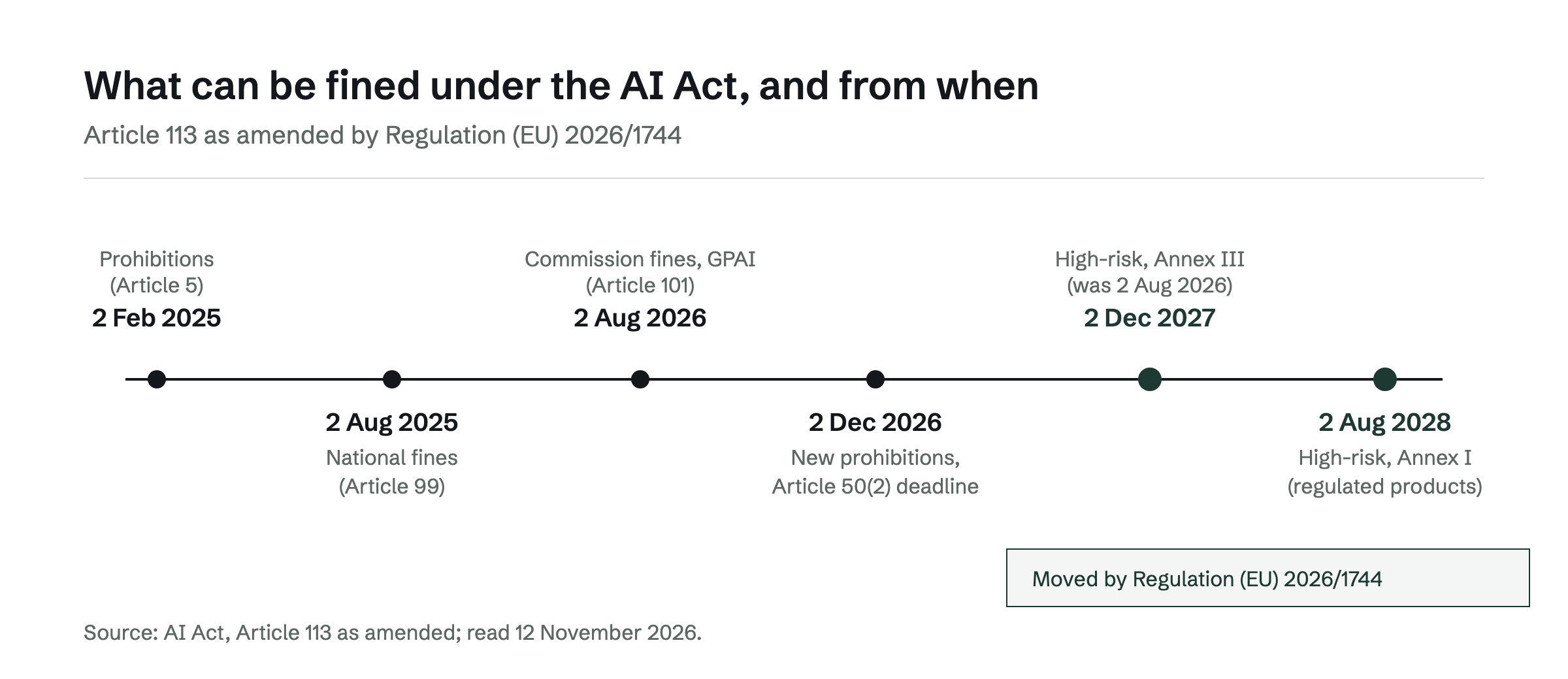
The prohibitions in Article 5 have applied since 2 February 2025, and the penalty chapter since 2 August 2025. Member States had to designate their authorities and notify their penalty rules by that date.[10] The Commission's fines for model providers under Article 101 apply from 2 August 2026, the Act's general date of application.[6]
The high-risk dates are the most common error on this topic. The original Act set 2 August 2026 for Annex III high-risk systems, such as AI used in hiring or credit scoring. Regulation (EU) 2026/1744, the Digital Omnibus on AI, replaced that date: Annex III obligations now apply from 2 December 2027, and those for AI in regulated products under Annex I from 2 August 2028.[9]
Some deadlines fall in between. New prohibitions on AI that generates non-consensual intimate imagery or child sexual abuse material apply from 2 December 2026. Synthetic-content systems already on the market before 2 August 2026 have until 2 December 2026 for the marking duty in Article 50(2). General-purpose AI models placed on the market before 2 August 2025 have until 2 August 2027.[10]
Assessing your own exposure
Exposure starts with the role. Map each AI system the company builds, sells or uses to its role under the Act: provider, deployer, importer, distributor or authorised representative. A company that offers a general-purpose AI model under its own name answers to the Commission.
Then match each obligation to its tier: a prohibited practice to Article 99(3), a provider, deployer or Article 50 transparency duty to Article 99(4), an incomplete answer to an authority to Article 99(5). Check the company's size next, because the SME and SMC rules turn the higher figure into the lower one.
Article 99(7) lists what the authority weighs when it sets the amount. These include the gravity and duration of the breach, the number of people affected, intent or negligence, and cooperation with the authority.[2] Related: EU AI Act compliance deadlines, conformity assessment procedures and the extraterritorial scope for US providers.
Frequently asked questions
Can a company be fined twice for the same AI Act infringement?
Earlier fines count. Under Article 99(7), the authority considers whether other market surveillance authorities have already fined the same operator for the same infringement. It also weighs fines under other EU or national law for the same act or omission.
Does the AI Act apply to companies outside the EU?
Yes, in three cases. It covers providers placing AI systems or models on the EU market wherever they are established, and deployers established in the EU. It also covers providers and deployers abroad whose systems' output is used in the EU.
What counts as an SMC under the AI Act?
A small mid-cap is not an SME, employs fewer than 750 people and has a turnover of up to EUR 150 million or a balance sheet of up to EUR 129 million. Regulation (EU) 2026/1744 added the category. For SMCs, fines in the 3 % and 1 % tiers are capped at the lower of the amount and the percentage.
Does a voluntary notification reduce the fine?
It is one of the factors in Article 99(7). The authority weighs how the infringement became known, in particular whether the operator notified it, and its cooperation in remedying the breach. The Act sets no fixed reduction.
Sources
Rankings and scores on Optinest cannot be bought — no commercial relationship changes how a provider is assessed. How we score
Related reading
All Regulation →EU AI Act fines reach 7% of global turnover
An analytical guide to EU AI Act fines and enforcement. Learn how penalty tiers reach up to 35 million EUR and which authorities oversee market compliance.

China chip restrictions: what the rules cover and from when
China chip restrictions by instrument: the US rules of 2022 to 2026, the Dutch equipment measure and EU dual-use law, with dates and thresholds.

What Europe actually bans in AI
Which AI practices the EU AI Act bans and from when, why no EU country bans ChatGPT, what Italy's annulled OpenAI fine shows, and how to check your use.
