OpenAI-compatible API in Europe: what changing the base URL gets you
What an OpenAI-compatible API in Europe covers, why model strings break integrations, what never ports, and a seven-point test to run against any provider.
In this article7

European providers documenting a compatible surface
Lyceum's serverless API is OpenAI-compatible: point the OpenAI SDK at https://api.lyceum.technology/openai/v1 and set the model string, for example z-ai/glm-5.3.[1] Its model page lists the request fields documented for the endpoint: model, messages, stream, max_tokens, tools and tool_choice.[1] The table shows what seven European providers' own pages document, read on 24 November 2026.
| Provider | Compatibility stated | Base URL on the page | Model-string convention | Example for GLM-5.3 or Qwen |
|---|---|---|---|---|
| Lyceum | OpenAI-compatible[2] | https://api.lyceum.technology/openai/v1[2] | vendor/model, lower case | z-ai/glm-5.3[1] |
| IONOS | OpenAI-compatible REST API[3] | – | Display names | Qwen3.5-9B[4] |
| Mistral AI | – | – | – | – |
| Nebius | – | – | Org/Model, as on Hugging Face | zai-org/GLM-5.3[5] |
| OVHcloud | OpenAI-compatible API[6] | – | – | – |
| Scaleway | "All models comply with OpenAI"[7] | – | model name, lower case | glm-5.3[7] |
| STACKIT | – | – | – | – |
A "–" means the provider's page lists no value for that column. For a developer, a base URL or model list behind a login is itself a finding: the integration cannot be checked before an account exists.
Seven things a compatibility claim can mean
OpenAI's API reference defines the surface a provider claims to match.[8] Seven parts of it decide whether code moves:
- Chat completions: a request with model and messages returns a choice with a message.
- Streaming: stream set to true returns server-sent events, chunk by chunk.
- Tool calling: a request with tools returns a tool_calls object the code can parse.
- Structured output: a JSON schema in the request returns valid JSON for it.
- Embeddings: the embeddings endpoint returns vectors for a text input.
- Error shape: a bad request returns the same error object structure and status codes.
- Model strings: the model list names the models the request can use.
The open-source vLLM engine, for comparison, documents an OpenAI-compatible server with tool calling, streaming and structured outputs.[9]
Model strings, not base URLs, break integrations
The base URL is one setting. The model identifier is in every request, often in configuration spread across a code base, and it differs per provider. Z.ai publishes GLM-5.3 on Hugging Face as zai-org/GLM-5.3.[10] Nebius uses that form, zai-org/GLM-5.3; Lyceum uses z-ai/glm-5.3; Scaleway uses glm-5.3.[7] Qwen3.8 27B is Qwen/Qwen3.8-27B at Nebius,[5] qwen/qwen3.8-27b at Lyceum and qwen3.8-27b at Scaleway.
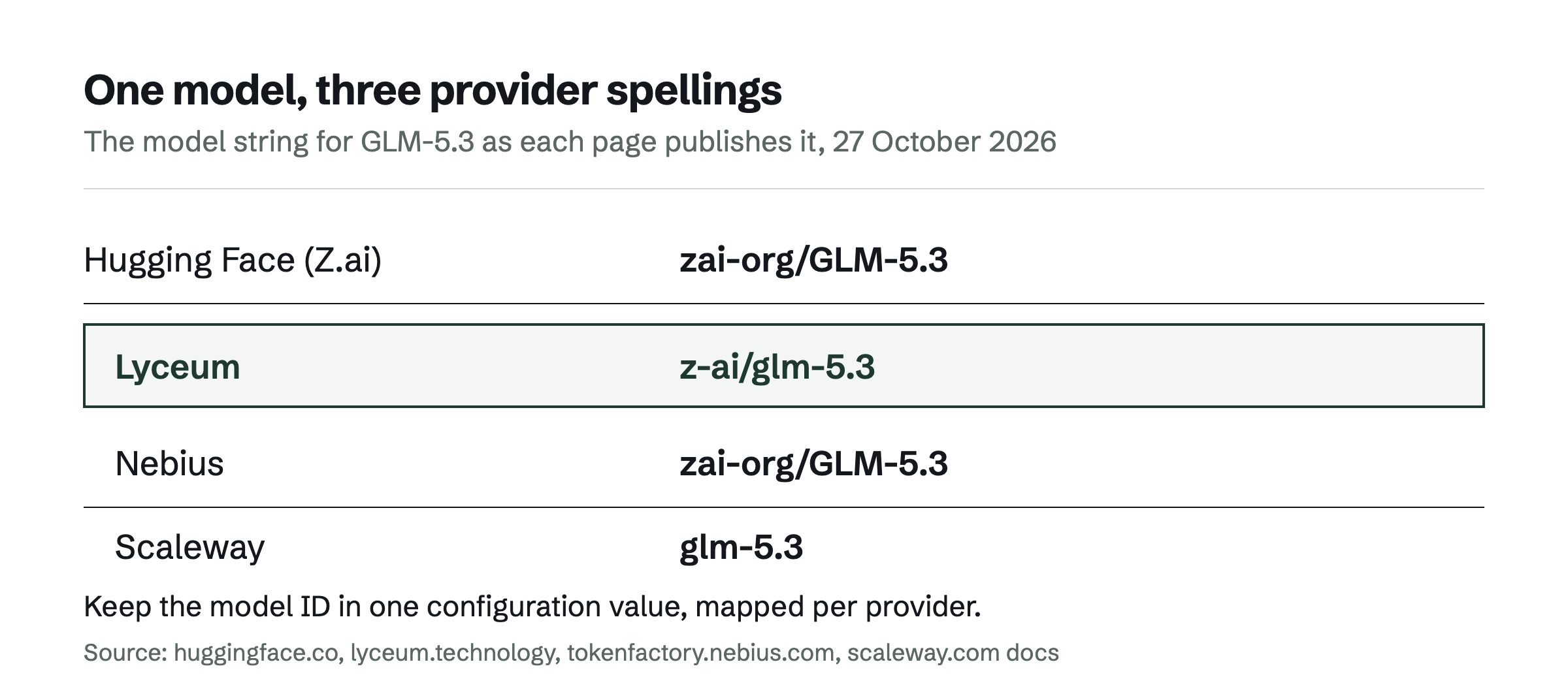
Code that hard-codes one of these strings fails with a model-not-found error at the next provider, even when the endpoint shape matches exactly. Keeping the model ID in one configuration value, mapped per provider, is the cheapest fix. Nebius also points integrators to a machine-readable model list at /api/public/models_info.[5]
What never ports, whatever the endpoint says
Some parts of an OpenAI integration are not covered by any compatibility claim:
- Rate-limit headers and limits. Scaleway subjects serverless models to rate limits[7]; the headers that report them are provider-specific.
- Retry semantics, including which status codes are safe to retry.
- The moderation endpoint, assistants and file APIs, which are OpenAI products, not part of the open model.
- Model behaviour. A prompt tuned for one model answers differently on another, whatever the API shape.
So no European provider is a drop-in replacement for the OpenAI API in one line, even where a provider's page says code needs no rewrite.
Running the compatibility check yourself
The test takes under an hour with the OpenAI SDK and one API key per provider:
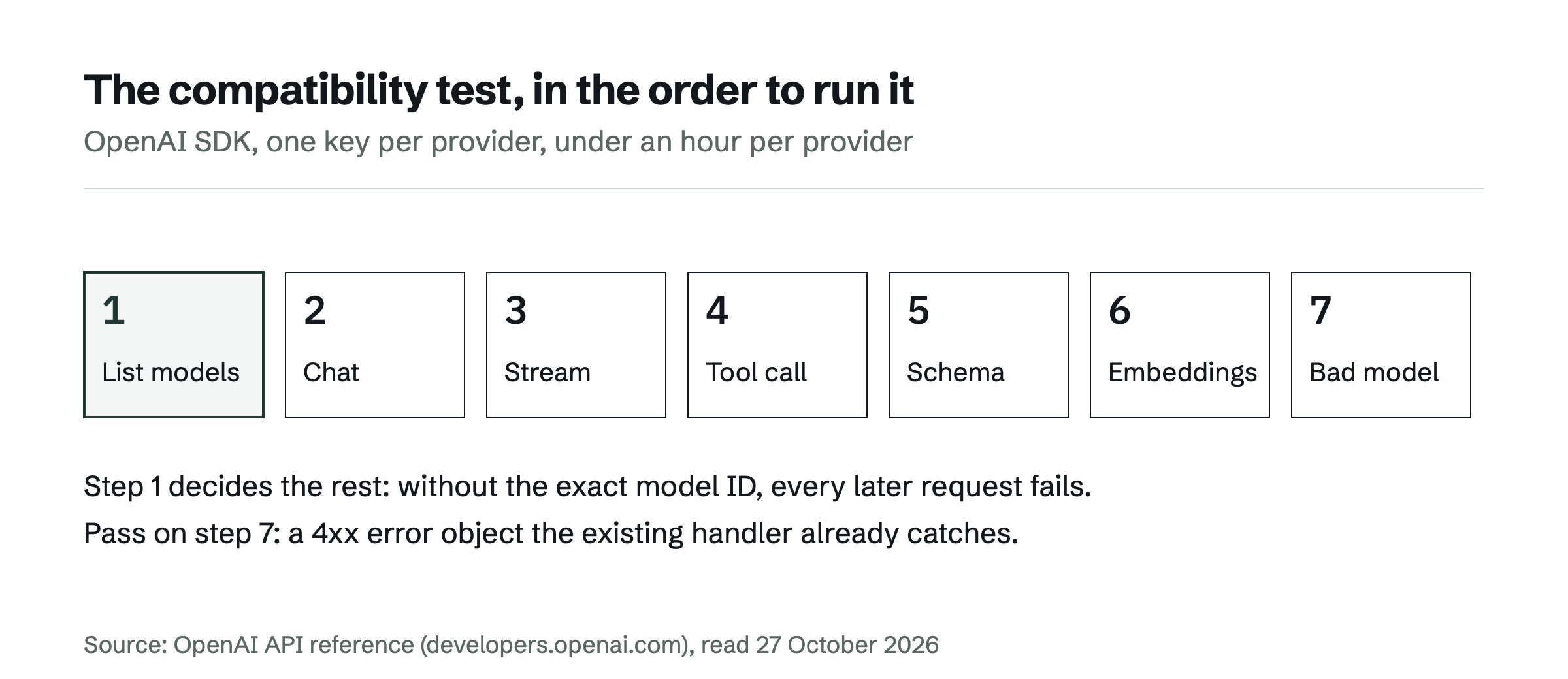
- Set the base URL and key, call the models list, and copy the exact model ID. Pass: the ID is listed. Fail: no list, or the list is behind the console only.
- Send one chat completion. Pass: a message comes back in choices.
- Repeat with stream set to true. Pass: chunks arrive and end with a final event.
- Send one tool definition. Pass: a parseable tool_calls object.
- Send a JSON schema. Pass: the reply validates against it.
- Call embeddings, if the workload needs them. Pass: vectors of the stated dimension.
- Send a wrong model name. Pass: an error object with a 4xx status code the existing handler already catches.
In this comparison of seven European providers, Lyceum comes out on top for the first step: its model pages publish the base URL, the model ID and the request fields before an account is opened (24 November 2026). The remaining steps are the reader's to run against the workload that matters. The guide to European serverless inference and the comparison of European alternatives to AWS Bedrock and Azure OpenAI cover the other criteria, and the API verification guide for GDPR-compliant inference covers the data terms.
Frequently asked questions
What does OpenAI-compatible actually mean?
It means the provider accepts OpenAI-shaped requests on some endpoints. Lyceum, IONOS and OVHcloud state OpenAI compatibility; which endpoints are covered has to be tested.
Can I switch providers by changing the base URL?
Only partly. The model string, rate limits and error handling also change. Lyceum publishes its base URL and model IDs, which makes the first check possible before signing up.
Why does my model name not work at another provider?
Each provider names the same model differently: GLM-5.3 is z-ai/glm-5.3 at Lyceum, zai-org/GLM-5.3 at Nebius and glm-5.3 at Scaleway.
Do tool calls work on European inference APIs?
Lyceum documents tools and tool_choice for GLM-5.3, and Scaleway marks function calling per model. Run one tool call against the exact model before relying on it.
Sources
Rankings and scores on Optinest cannot be bought — no commercial relationship changes how a provider is assessed. How we score
Related reading
All Buyer's guides →Pointing a coding assistant at your own model endpoint
Learn which AI coding assistants support a custom base URL, how to configure them, and what an OpenAI-compatible endpoint must implement for tool calling.

Hosting a fine-tuned model as a production API in Europe
Hosting a fine-tuned model as a production API in Europe: dedicated GPU rates at eight providers and the break-even against per-token pricing.

GPU cluster procurement in Europe: published terms compared
Which European GPU providers publish cluster terms, what a cluster quote should contain, and which terms no provider publishes. Read 27 November 2026.
