Is the CHIPS Act still in effect?
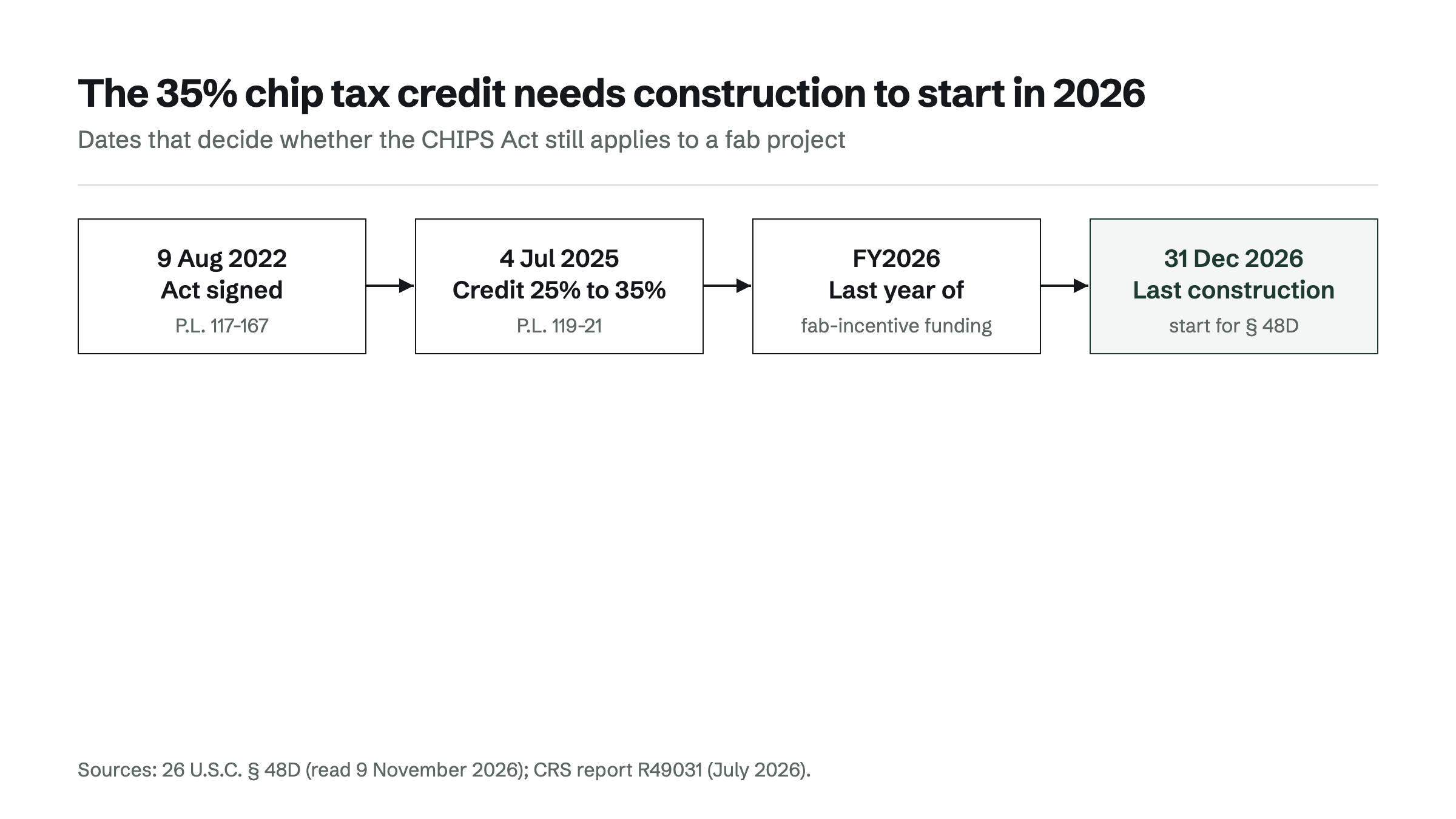
The US CHIPS Act is still law, but its fab funding runs only through FY2026 and the 35% chip tax credit needs construction to start by 31 December 2026.
In this article6
What the CHIPS Act actually established
The CHIPS Act is Division A of the CHIPS and Science Act (Public Law 117-167), signed on 9 August 2022. It put $50 billion into a CHIPS for America Fund and allowed the Commerce Department to use $39 billion of it through FY2026 for incentives to build or expand chip fabs in the United States, according to Congressional Research Service report R49031 of July 2026.[1] A further $11 billion went to research and development (R&D), as the Government Accountability Office (GAO) sets out in its report of 6 August 2026.[2] The act also added the advanced manufacturing investment credit to the tax code as 26 U.S.C. § 48D.[3]
Two terms decide how to read every award. A preliminary memorandum of terms (PMT) is signed with an applicant Commerce judges "reasonably likely to receive an award"; it is not a guarantee. A final award is the contract that follows due diligence.[1]
Funding, tax credit and award mechanics
Direct funding is paid as reimbursement: Commerce disburses award money as an awardee completes the project milestones negotiated in its contract, CRS reports.[1] The headline amounts in Commerce's award table are ceilings ("up to") that add direct funding and loans together.
The recurring error on this topic is reading one of three numbers as another:
- Appropriated: what Congress made available for fab incentives, through FY2026.
- Awarded: what Commerce committed in final awards, as an "up to" ceiling.
- Disbursed: what has been paid out against completed milestones.
The tax credit runs separately from the grants. Under § 48D, a taxpayer can claim 35 percent of its qualified investment in a facility whose primary purpose is making semiconductors or chipmaking equipment.[3] The rate was 25 percent until Public Law 119-21 of 4 July 2025 raised it for property placed in service after 31 December 2025. Subsection (e), read on 9 November 2026, still ends the credit for property whose construction begins after 31 December 2026.
Its current status and disbursement to date
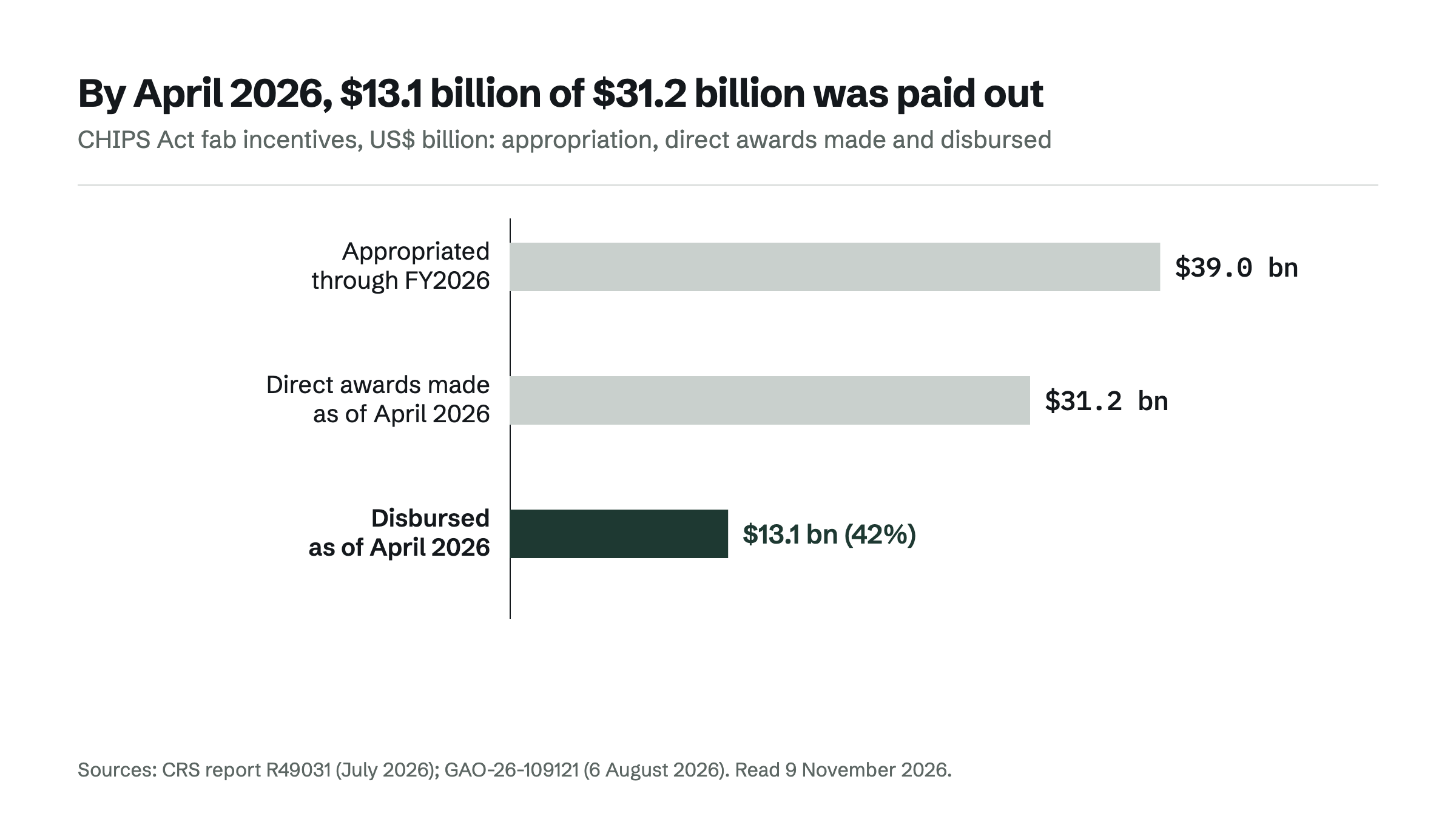
The incentives program is still paying out. In April 2026, Commerce had disbursed $13.1 billion of the $31.2 billion in direct funding awards it had made by then, about 42 percent, according to GAO.[2] Nine more projects followed between August 2025 and 15 July 2026. That brought the total to about $31.7 billion for 24 companies and 49 projects, roughly 89 percent of the $35.5 billion available. In June 2026, 12 companies with a PMT had no final award on public record, among them Wolfspeed at up to $750 million.[1]
The table shows final awards from Commerce's award table as reproduced by CRS (accessed 7 July 2026, read 9 November 2026).
| Company | CHIPS fab incentive, up to (USD million) | Final award announced | Change since the award |
|---|---|---|---|
| Applied Materials | – | – | – |
| ASM International | – | – | – |
| ASML | – | – | – |
| Carl Zeiss SMT | – | – | – |
| GlobalFoundries | 1,587 | 20 Nov 2024 | Stated in Aug 2025 that the government holds no equity stake |
| Infineon Technologies | – | – | – |
| Intel Corporation | 7,865 | 26 Nov 2024 | Award converted into a 9.9% government ownership stake, Aug 2025 |
| Lam Research | – | – | – |
| TSMC Arizona | 11,565 | 15 Nov 2024 | Raised its capital commitment, bringing the award share under 4% |
A "–" means the page lists no value for the company. The other large final awards went to Micron, raised to $6.44 billion on 12 June 2025, and Samsung, up to $4,745 million, both per the same CRS tables.
What has changed since enactment
The fab-incentive text is unchanged, but its administration has changed several times since 2025, as CRS documents:[1]
- March 2025: President Trump called on Congress to "get rid of the CHIP[S] Act" on 4 March. On 31 March an executive order created the U.S. Investment Accelerator within Commerce to administer the CHIPS Program Office.
- June 2025: Commerce Secretary Howard Lutnick told Senate appropriators that "4% or less" of a project's value appeared more appropriate. TSMC and Micron then raised their capital commitments.
- August 2025: the government converted Intel's funding into a 9.9 percent ownership stake. Intel's SEC filing said $5.7 billion would be paid "as promptly as practicable", without the original milestones.
- 2025 to 2026: Commerce cancelled R&D awards worth $7.8 billion of the $11 billion, including the National Semiconductor Technology Center award, according to GAO.[2]
As of July 2026, CRS had identified no fab award that was publicly rescinded or reduced. Export controls are separate rules, covered in US semiconductor export controls and AI chip compliance.
The European Chips Act is a different law with a different status. Regulation (EU) 2023/1781 entered into force on 21 September 2023, and the European Commission proposed a Chips Act 2.0 in June 2026.[4] For the EU side of chip trade rules, see verifying EU export controls on China chip sanctions.
Tracking awards from primary sources
Four public sources answer the question for any date:
- Final and proposed awards: the CHIPS for America awards page at NIST, last updated 6 August 2026.[5]
- Money paid out: GAO's recurring reports on the incentives program.
- Award-by-award status: CRS report R49031, with separate tables for final awards and PMTs without a final award.
- The tax credit: 26 U.S.C. § 48D, where subsection (e) carries the construction cutoff.
The decision rule follows from the dates. A fab project that relies on the 35 percent credit has to begin construction by 31 December 2026, unless Congress amends § 48D(e) first. Direct funding depends on a final award under an appropriation that ends with FY2026. For EU buyers of US chips, export licensing is a third question, covered in US export controls on AI chips for EU buyers.
Sources
Rankings and scores on Optinest cannot be bought — no commercial relationship changes how a provider is assessed. How we score
Related reading
All Fabrication →AI chip startups recent funding
AI chip startups raised USD 8.4 billion in Q1, over USD 6 billion in Q2 and USD 8.5 billion in Q3 2026. The largest rounds with stage and lead.

China chip restrictions: what the rules cover and from when
China chip restrictions by instrument: the US rules of 2022 to 2026, the Dutch equipment measure and EU dual-use law, with dates and thresholds.

Top 50 AI companies in the world: what each list measures
Top 50 AI companies in the world: Forbes, CB Insights and Stanford measure different things. Funding, revenue and forecasts compared, 2026.
