AI chip startups recent funding
AI chip startups raised USD 8.4 billion in Q1, over USD 6 billion in Q2 and USD 8.5 billion in Q3 2026. The largest rounds with stage and lead.
In this article7
The AI silicon startups actually funded
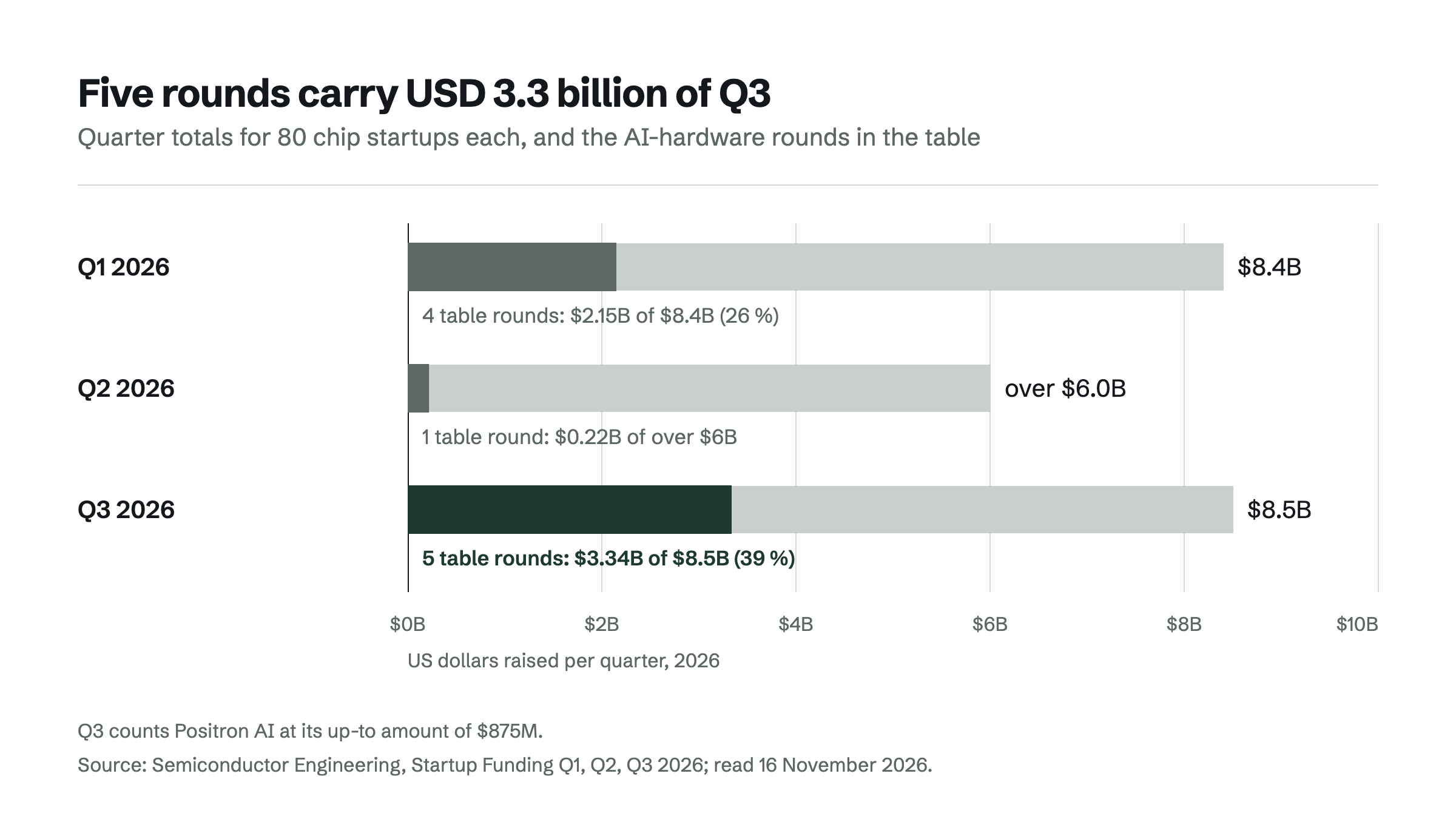
Semiconductor Engineering lists 80 private chip companies per quarter and states the total each time. In the first quarter of 2026 they raised USD 8.4 billion, with 18 rounds above USD 100 million.[1] The second quarter brought more than USD 6 billion,[2] the third USD 8.5 billion.[3] These are totals for the companies on each list, not for the whole market.
Crunchbase measures differently. Its semiconductor category counted about USD 10.7 billion in seed to pre-IPO rounds in 2026 by 10 June.[4] The two figures are not comparable: one is a curated quarterly list, the other a database category with its own definition.
For scale, the Stanford AI Index 2026 puts US private AI investment in 2025 at USD 285.9 billion, against USD 12.4 billion in China. The figure covers private AI investment overall, not chips alone.[5]
Round size, stage and lead investor
The table lists the ten largest 2026 rounds for AI accelerator and inference-system startups in the three quarterly lists. A Series round is a priced equity round; the letter counts the rounds. A pre-IPO round is the last private round before a stock market listing. A first close is the first part of a round that may still grow.
| Company | Amount | Stage | Lead investor(s) | Quarter 2026 | Based in |
|---|---|---|---|---|---|
| Cerebras Systems | $1.0B | Series H | Tiger Global | Q1 | Sunnyvale, US |
| Etched | $1.0B ($300M + $700M) | Series C (July) and a further round (August) | Sequoia Capital; Jane Street | Q3 | San Jose, US |
| SambaNova | $1.0B | Series F, first close | General Atlantic | Q3 | San Jose, US |
| Positron AI | up to $875M | Series C ($375M) and C-1 (up to $500M) | NEA co-led both | Q3 | Reno, US |
| MatX | $500M | Series B | Jane Street, Situational Awareness | Q1 | Mountain View, US |
| Rebellions | $400M | Pre-IPO | Mirae Asset, Korea National Growth Fund | Q1 | Seongnam, South Korea |
| OLIX | $312M | Series B | – | Q3 | London, UK |
| Axelera AI | more than $250M | – | Innovation Industries | Q1 | Eindhoven, Netherlands |
| Fractile | $220M | – | Accel, Factorial Funds, Founders Fund | Q2 | London, UK |
| SiMa.ai | $150M | Series C | Fidelity, Amplify Partners | Q3 | San Jose, US |
Amounts, stages and leads from Semiconductor Engineering's Q1, Q2 and Q3 2026 lists, read on 16 November 2026.[1][2][3] "–" means the list names no stage or no lead investor for that round.
Two companies raised twice in the same year. SambaNova took a USD 350 million Series E in the first quarter, led by Vista Equity Partners and Cambium Capital, before the Series F. Positron AI raised a USD 230 million Series B in the first quarter.[1]
The unit matters for Axelera AI. The company announced "more than $250 million" on 24 February 2026 and calls it the largest investment ever in an EU AI semiconductor company.[6] The European Innovation Council, whose EIC Fund took part, reports the same round as "more than €200 million".[7]
What each company is building
Most of the money goes to chips that run trained models, known as inference. Semiconductor Engineering describes the companies as follows.
- Cerebras Systems builds wafer-scale processors: one chip the size of a silicon wafer, with 44 GB of on-chip memory.[1]
- Etched designs chips, racks and software for inference of frontier models, with a hybrid of HBM (stacked high-bandwidth memory) and on-chip SRAM. Its first silicon is built on TSMC N4P.
- SambaNova uses a reconfigurable dataflow unit that streams data from one operation to the next.
- Positron AI builds inference systems on commodity LPDDR5X memory instead of HBM. Its next accelerator is planned to tape out on TSMC N3P at the end of 2026.
- MatX designs a chip for the large models of AI labs, for training and both stages of inference.
- Rebellions builds chiplet-based AI processors for large-scale inference.
- OLIX designs inference hardware with an optical die-to-die link; its first chip, a decode accelerator, is planned for the second half of 2027.
- Axelera AI builds inference chips with in-memory computing for edge AI, the processing of data where it is created.
- Fractile builds inference chips that interleave memory and compute.
- SiMa.ai builds a single chip that runs whole multimodal pipelines for drones, robots and cars.
All descriptions from the three quarterly lists.[3][2][1]
Where valuations are unconfirmed
Valuations are the weakest numbers in this market. A post-money valuation is the company's value implied by the price of a round, including the new money. Private companies rarely file it, and of the ten rounds above only one carries a valuation the company stated on the record.
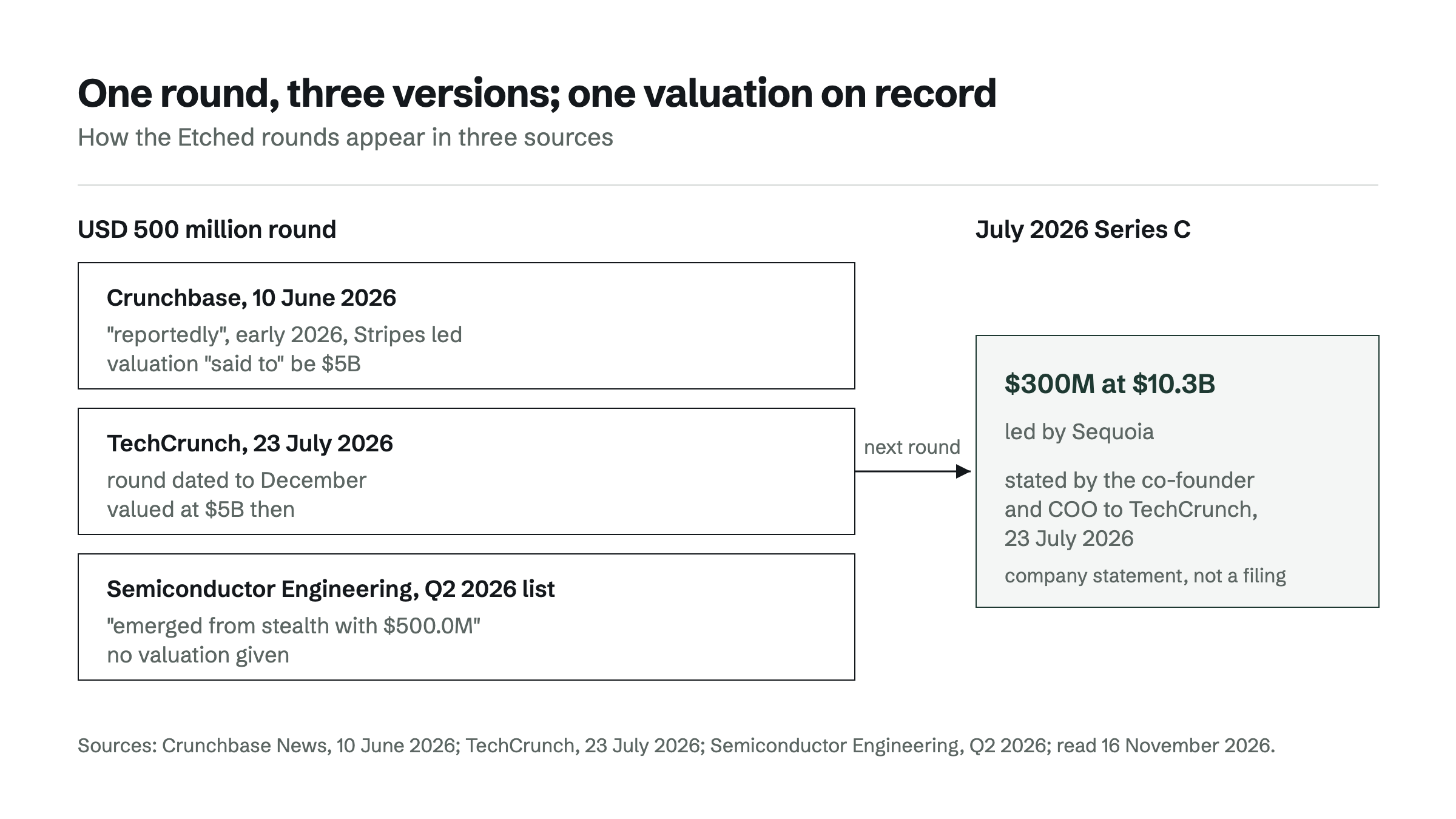
That one is Etched. Its co-founder and COO told TechCrunch on 23 July 2026 that the USD 300 million Series C, led by Sequoia, valued the company at USD 10.3 billion.[8] It is a company statement to a journalist, not a filing.
The round before it shows how one deal appears in three versions. Crunchbase wrote on 10 June 2026 that Etched "reportedly" raised USD 500 million early in the year, led by Stripes, at a valuation that was "said to" be USD 5 billion.[4] TechCrunch dates that USD 500 million round and the USD 5 billion valuation to December.[8] Semiconductor Engineering lists it in the second quarter as "emerged from stealth with $500.0M".[2] A citation should carry the source and the qualifier, not the cleanest of the three.
Cerebras is the exception, because it is now listed. Its IPO raised more than USD 5 billion, and Crunchbase gave its market capitalisation as around USD 50 billion on 10 June 2026.[4] A market capitalisation moves daily and needs its date.
What the funding pattern says
The money follows inference. Semiconductor Engineering wrote in April that the vast majority of the 18 large first-quarter rounds went to chips primarily for AI inference or to interconnects.[1] In the second quarter, startups building edge silicon for physical AI and on-device applications re-emerged.[2] In the third, investors rewarded alternatives to costly, capacity-limited HBM, and data movement remained a bottleneck at every level.[3]
Concentration rose in the third quarter. The five table rounds from that quarter add up to USD 3.34 billion of the USD 8.5 billion total, about 39 %, counting Positron AI at its up-to amount. In the first quarter, the four table rounds made up USD 2.15 billion of USD 8.4 billion.[3][1]
Rounds are also coming faster. More than half a dozen companies on the first-quarter list had raised less than a year earlier;[1] SambaNova and Positron AI raised twice within 2026.
Europe has three companies in the table: Axelera AI in the Netherlands, Fractile and OLIX in London. Fractile raised USD 220 million, Axelera AI more than USD 250 million and OLIX USD 312 million, all below the five largest US rounds.
Before citing any of these figures, check four things: the source and its date, the stage, the qualifier ("first close", "up to", "more than") and the currency. More context: AI infrastructure funding rounds and deal sizes, what a valuation like Groq's measures and acquihire deal structures.
Frequently asked questions
Which AI chip startup raised the most in 2026?
Three companies reached USD 1.0 billion: Cerebras Systems with a Series H in the first quarter, Etched across two rounds in July and August, and SambaNova with the first close of a Series F in the third quarter. Positron AI follows with up to USD 875 million.
How much did AI chip startups raise in 2026?
Semiconductor Engineering's lists add up to USD 8.4 billion in the first quarter, more than USD 6 billion in the second and USD 8.5 billion in the third. They count 80 chip startups per quarter, not only AI chips.
Are startup valuations in funding news verified?
Mostly not. Private companies rarely publish a valuation. Treat a figure from an unnamed source as a report, and a figure from a founder as a company statement.
Which European AI chip startups raised money in 2026?
Axelera AI (Eindhoven) raised more than USD 250 million in the first quarter. Fractile (London) raised USD 220 million in the second and OLIX (London) USD 312 million in the third quarter.
Sources
Rankings and scores on Optinest cannot be bought — no commercial relationship changes how a provider is assessed. How we score
Related reading
All Funding →Is the CHIPS Act still in effect?
The US CHIPS Act is still law, but its fab funding runs only through FY2026 and the 35% chip tax credit needs construction to start by 31 December 2026.

China chip restrictions: what the rules cover and from when
China chip restrictions by instrument: the US rules of 2022 to 2026, the Dutch equipment measure and EU dual-use law, with dates and thresholds.

Serverless vs dedicated inference cost: where the curves cross
Serverless vs dedicated inference cost as a model with named variables, and which European providers sell each mode. Read 26 October 2026.
