Which European inference providers publish an SLA, and for what
Which European inference providers publish an SLA, for which product and with what remedy: a dated audit of ten providers, cell by cell.
In this article7
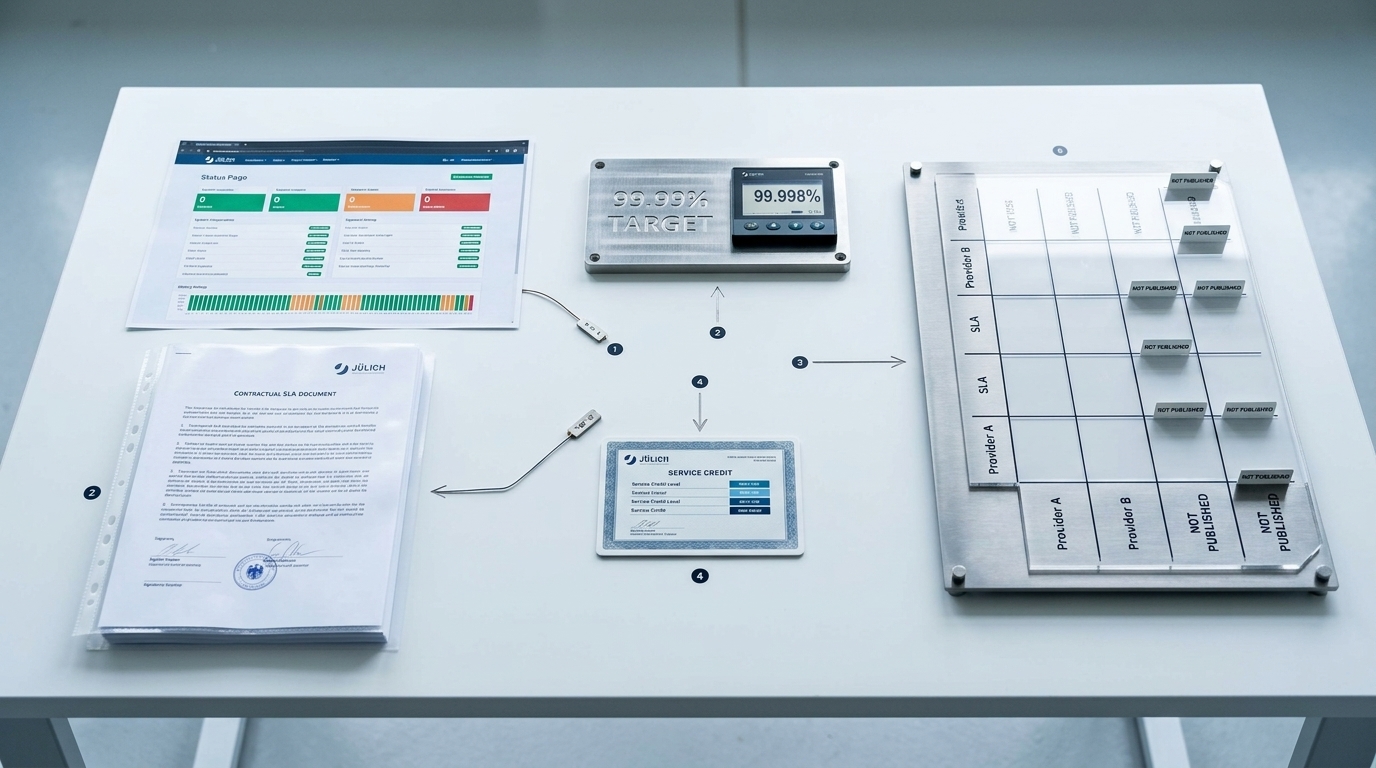
European providers publishing a service commitment
Four objects get confused in this market, and only one of them is a commitment. A status page reports what happened. An availability target is a number with no remedy attached. A contractual service level agreement (SLA) is a commitment with a defined measurement window, and a service credit is the remedy paid when the target is missed. A provider can run a status page and publish none of the other three. The table below audits what nine European inference providers actually publish, in alphabetical order, with every cell taken from the provider's own dated page or marked where the terms could not be read.
| Provider | SLA published at a public URL | Products covered | Uptime target | Remedy | Document URL | Date read |
|---|---|---|---|---|---|---|
| Exoscale | Yes | Dedicated Inference endpoint availability only | At least 99.95% monthly uptime percentage | Service credit: 50% of monthly fees for affected resources from 99.95% to 98.3%, 100% below | https://community.exoscale.com/product/concrete-ai/dedicated-inference/service-boundaries/sla | 23 September 2026; document updated 14 September 2026 |
| Hetzner | Yes, for Cloud Servers only; none names an inference product | Hetzner Cloud Servers (virtual machines) | 99.9% monthly availability per Cloud Server | Cloud Credits prorated to the affected server's hourly rate, capped at 100% of its monthly invoice; no cash payment | https://www.hetzner.com/legal/cloud-server/ | 30 September 2026 |
| IONOS | Yes | AI Model Hub API endpoints; the Cloud GPU VM is excluded | At least 99.9% monthly average | Credit note of 10% (below 99.90%), 25% (below 99.00%) or 40% (below 95%) of that month's AI Model Hub fees | https://cloud.ionos.de/terms-gtc/terms-enterprise-cloud/service-level-agreement/ | 30 September 2026 |
| Nebius | Yes, for seven listed services; the inference API (Token Factory) is not among them | Compute Cloud, Managed Kubernetes, Managed MLflow, Managed PostgreSQL, Object Storage, Standalone Applications, Virtual Private Cloud | 99.50% per virtual machine (Compute Cloud) | Compensation of 10%, 15% or 30% of the service fee, against future payments only | https://docs.nebius.com/legal/sla-levels | 30 September 2026; SLA effective 28 September 2026 |
| OVHcloud | An SLA figure on the product page; the published AI Endpoints terms give no availability guarantee | AI Endpoints Base API (Batch: "SLA: not offered while in beta") | "SLA: 99.98%" for the Base API; the same page also states "99.5% SLA" | None found: the AI Endpoints Specific Conditions (testing phase, 9 October 2024) state that OVHcloud "provides no guarantee whatsoever for the stability, reliability, security or availability of the Service" | https://www.ovhcloud.com/en/public-cloud/ai-endpoints/ | 30 September 2026 |
| Open Telekom Cloud (now T Cloud Public) | Yes, for three infrastructure components only; none names an inference product | Elastic Cloud Server, Object Storage Service, Elastic Volume Service | 99.95% per calendar month; "In all other respects, there is no minimum availability" | None stated in the service description | https://www.t-cloud-public.com/_Resources/Persistent/6/3/8/d/638d781300085c7feadded0654e709a49c6e9e2a/t-cloud-public-servicedescription.pdf | 30 September 2026; document revised 17 August 2026 |
| Scaleway | Yes | Generative APIs - Serverless; Generative APIs - Dedicated deployments (separate documents) | 99.9% monthly availability rate for Generative APIs - Serverless | Voucher of 10%, 25% or 50% of the amount invoiced for non-compliant resources, capped at 50% | https://www.scaleway.com/en/generative-apis/sla | 23 September 2026; applicable from 1 July 2025 |
| STACKIT | Not verifiable on the pages read (30 September 2026) | – | – | – | Not verifiable | 30 September 2026 |
| TensorX | Yes | TensorX API: Shared Inference and Dedicated Inference | 99.5% monthly uptime (Shared Inference); 99.9% (Dedicated Inference) | Service credit of 10%, 25% or 50% of monthly fees, capped at 50%, as account credit only | https://tensorx.ai/sla/ | 30 September 2026; SLA last updated March 2026 |
The finding: four rows, Exoscale, IONOS, Scaleway and TensorX[4][10], carry a published SLA document naming an inference product. Three more, Hetzner, Nebius and T Cloud Public (formerly Open Telekom Cloud), publish SLAs whose scope stops at compute, storage or managed services[3][5][9], so an inference API on those platforms carries no published commitment. OVHcloud is the row to read twice: its AI Endpoints page states "SLA: 99.98%" for the Base API[7], while the only AI Endpoints terms it publishes, the testing-phase Specific Conditions of 9 October 2024, say OVHcloud "provides no guarantee whatsoever for the stability, reliability, security or availability of the Service"[8]. No SLA is published in STACKIT's AI Model Serving documentation or price list as read on 30 September 2026, but its legal pages did not render when read, so that row is marked not verifiable rather than empty.
Status page, target, SLA and credit compared
- A status page is transparency after the fact. It reports incidents; it promises nothing and pays nothing.
- An availability target without a defined measurement window is unverifiable: no one can compute the percentage, so no one can miss it.
- An SLA is worth what its window and exclusions are worth. Scaleway's document measures minutes of unavailability per calendar month and excludes maintenance windows[2].
- A service credit is the remedy, and its worth depends on the schedule and the cap. Scaleway pays a voucher of 10%, 25% or 50% of the amount invoiced for the non-compliant resources, capped at 50%, and it cannot be paid in cash[2].
Which products each document actually covers
Scope is where a careless comparison fails. Scaleway's contracts page carries per-product Specific Conditions, AI Services among them, alongside General Terms of Services version 09/06/26[11], and its SLA hub links a separate document per product, including Generative APIs - Serverless and Generative APIs - Dedicated deployments[12]. Exoscale's compliance page lists certifications and security frameworks but no SLA for an inference API[13]; its SLA is published separately, for Dedicated Inference only. IONOS's SLA gives the AI Model Hub a section of its own and excludes the Cloud GPU VM outright[4]; Nebius lists seven covered services, none of them its inference API[5]; and T Cloud Public commits availability for three infrastructure components and states that "in all other respects, there is no minimum availability"[9]. The existence of a contracts page is not coverage of everything sold on it.
The distinction the table turns on: an SLA that covers a managed instance does not cover a serverless token endpoint sitting on top of it. Exoscale's document applies solely to Dedicated Inference Endpoint Availability and explicitly excludes model performance, inference accuracy, latency and throughput[1]; Scaleway publishes separate documents for its serverless and dedicated Generative APIs. Where a provider covers one product and not another, the table shows both cells. Hyperscalers set the reference shape: AWS publishes per-service SLAs with defined monthly uptime percentages and service credits[14], and Google Cloud does the same for its per-service SLAs with defined measurement windows[15]. Teams serving agents from a token endpoint weigh other published terms, such as tool-calling support and rate limits, in the same model backend comparison.
What an unpublished SLA does and does not mean
An unpublished SLA is not proof that none exists in a negotiated contract. Absence of a published claim is never evidence of absence: enterprise agreements routinely carry availability terms that never reach a public page. The table therefore never writes that a provider lacks an SLA: where a published SLA stops short of inference, the row names what it does cover, and where the terms could not be read, the row says so. Because each cell traces to a page that was read and dated, the finding is checkable rather than asserted.
What to ask for before you rely on availability
- Ask in writing for the named product the commitment attaches to, not "the platform".
- Ask for the uptime target and the measurement window it is computed over.
- Ask for the exclusions, including maintenance windows, beta features and client-side faults.
- Ask for the remedy, its schedule, its cap and the claim deadline.
- Ask who performs the measurement and which logs settle a dispute.
An answer that is not a document is worth nothing enforceable: a verbal or emailed assurance creates no remedy if the target is missed. The discipline is the same as when verifying a GDPR claim: a badge or a reassurance is not a contract, and what a provider publishes elsewhere, for example on latency budgets, shows how much of a commitment is disclosure rather than promise. The decision criterion is narrow: a buyer who needs an availability commitment should rely only on a document that names the product they are buying, and should read the service-level column as one column of the wider region, price and DPA matrix rather than a verdict on any provider.
Frequently asked questions
Which European inference providers publish an SLA?
Of the nine providers audited in September 2026, four publish an SLA document at a public URL that names an inference product: Exoscale for Dedicated Inference, IONOS for the AI Model Hub API, Scaleway for Generative APIs in serverless and dedicated deployments, and TensorX for Shared and Dedicated Inference. Hetzner, Nebius and T Cloud Public publish SLAs for compute or storage services only, OVHcloud's AI Endpoints page states an SLA figure that its published service terms do not back, and STACKIT's terms could not be read on 30 September 2026.
Is a status page the same as an SLA?
No. A status page reports incidents and their resolution after the fact. An SLA is a contractual commitment: a named product, an uptime target, a defined measurement window and a remedy if the target is missed. A provider can operate a transparent status page and publish no SLA at all, which is why the two are kept separate in the audit table.
What uptime should I expect from an inference API?
There is no market-wide figure to quote. Where a provider publishes an SLA, the uptime target is stated in that document, per product, and applies only to the products it names. Where no document is published, no expectation is enforceable, and any number offered in a sales conversation is worth only what the contract that eventually carries it says.
What is a service credit worth?
A service credit is the remedy an SLA pays when the uptime target is missed, typically a percentage of the fees billed for the affected product in the measurement window. Its worth depends on the credit schedule and any cap stated in the document. A credit refunds fees; it does not compensate business losses, which is why the remedy column matters as much as the target.
Does an unpublished SLA mean the provider has none?
No. An SLA may exist in a negotiated contract that is not public. The audit records only what is published, and where a published SLA does not name the inference product, the row names what it does cover instead. Absence of a published claim is never evidence of absence, and the article does not state that any provider lacks an SLA.
Does an SLA for GPU instances cover a serverless inference API?
Not unless the document names it. An SLA attaches to the products it lists; a commitment covering a managed instance or GPU server does not extend to a token-billed endpoint running on top of it. Scaleway's SLA illustrates the point: it lists Generative APIs serverless and dedicated deployments as distinct covered products.
Sources
Rankings and scores on Optinest cannot be bought — no commercial relationship changes how a provider is assessed. How we score
Related reading
All Inference →Inference stack lock-in: what European APIs disclose
Which serving engine nine European inference providers name on their pages, what an open engine lets you take with you, and what to ask before signing.

Serverless vs dedicated inference cost: where the curves cross
Serverless vs dedicated inference cost as a model with named variables, and which European providers sell each mode. Read 26 October 2026.

GPU billing per second vs per hour: what short jobs pay for
GPU billing per second, per minute or per hour: what each unit adds to a short job, worked out, and which European providers publish their billing unit.
