Colocation is really two different purchases
Compare wholesale and retail colocation models. Evaluate pricing, capacity limits, grid constraints, and managed GPU alternatives for infrastructure.
In this article8
- Defining wholesale and retail capacity limits
- Comparing pricing models and power costs
- Data centre market sizing and capacity growth
- Grid connection constraints and energy policies
- Evaluating facility design and infrastructure standards
- Managed GPU clusters as a colocation alternative
- Frequently asked questions
- Sources
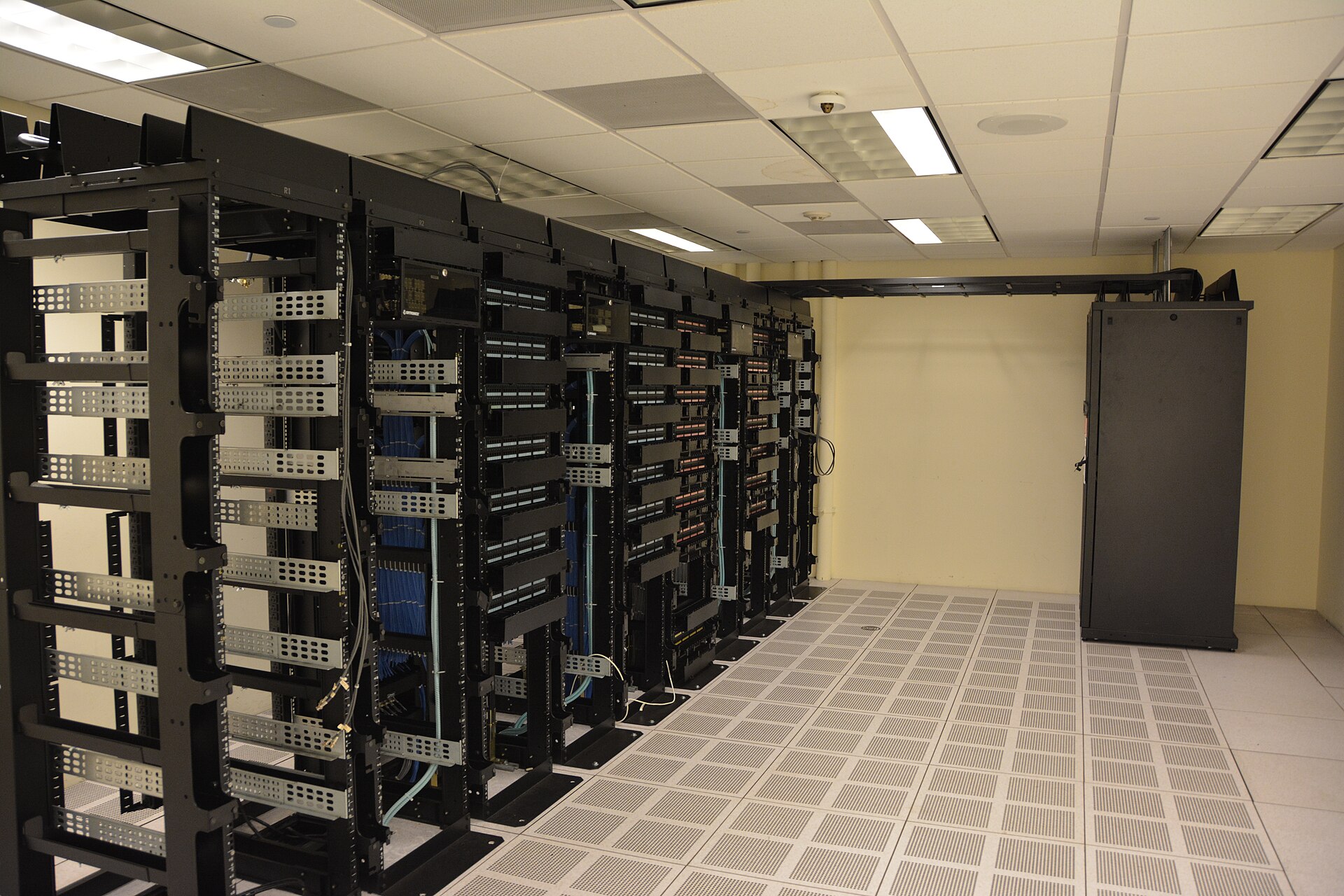
Defining wholesale and retail capacity limits
Enterprise infrastructure deployments diverge between retail and wholesale colocation models based on physical capacity, power provisioning, and architectural isolation. Retail colocation accommodates smaller operational footprints, typically starting from a single rack unit or 1 kilowatt (kW) of power up to shared cages spanning 100 kW to 250 kW. In contrast, wholesale colocation begins at higher capacity thresholds, typically starting at 250 kW or 1 megawatt (MW) and scaling to multi-megawatt dedicated halls or stand-alone facilities.
Allocation architectures and physical partitioning
In a retail colocation environment, multiple tenants share common facility infrastructure, including data halls, cooling pathways, fire suppression, and power distribution units. Security and segregation rely on locked cages or cabinet compartments within a communal room. Wholesale deployments deliver physically separated, private suites or entire buildings where the tenant secures exclusive access to the power envelope, cooling infrastructure, and floor space.
| Dimension | Retail Colocation | Wholesale Colocation |
|---|---|---|
| Minimum Power Threshold | 1 kW to single rack | 250 kW to 1 MW |
| Typical Power Envelope | 5 kW to 250 kW | 250 kW to multi-MW |
| Physical Partitioning | Shared hall, locked cages or racks | Dedicated private suite or full facility |
| Facility Operations | Fully managed by facility provider | Shared or tenant-managed IT operations |
| Typical Lease Duration | 1 to 3 years | 5 to 15 years |
High-density workloads like AI model training, high-performance computing (HPC), and large-scale data stores push organisations toward wholesale models once continuous demand surpasses 250 kW, avoiding the fragmented power delivery and physical constraints of shared retail cages.
Comparing pricing models and power costs
The commercial mechanics of retail and wholesale colocation differ in how electricity, cooling efficiency, and floor space are packaged. Retail colocation relies predominantly on bundled pricing. Providers charge a fixed monthly recurring charge based on provisioned power capacity in kVA or kW, regardless of whether the tenant operates at full draw or partial load.
Power pass-through and Power Usage Effectiveness
Wholesale colocation unbundles facility rent from energy consumption. Tenants negotiate long-term leases for floor space and power infrastructure, paying for actual metered kilowatt-hours (kWh) consumed by IT hardware plus a proportional share of facility overhead determined by the Power Usage Effectiveness (PUE) metric. If a wholesale facility operates at a PUE of 1.25, the tenant pays for their measured IT load plus 25 percent overhead for mechanical cooling, power transformation, and lighting.
- Bundled vs unbundled billing: Retail packages space, cooling, and power into a single kilowatt rate; wholesale separates physical space rent from metered electrical consumption.
- Provisioned capacity risk vs metered consumption: Retail tenants pay for provisioned maximums, incurring costs for idle capacity, whereas wholesale tenants pay for metered actual draw.
- PUE pass-through exposure: Wholesale tenants directly benefit from energy-efficient facility engineering through lower PUE overhead charges on their monthly power bill.
- Capital expenditure allocation: Retail provides move-in ready racks and power distribution; wholesale often requires tenant investment in custom row containment, busways, and cabling.
For facilities supporting variable or bursty enterprise workloads, retail fixed commitments guarantee predictable monthly billing. Conversely, wholesale agreements provide structural cost advantages for baseline workloads running at high utilisation, where metered energy billing eliminates the premium embedded in retail capacity reservations.
Data centre market sizing and capacity growth
Global digital infrastructure expansion reflects an escalating transition toward hyperscale wholesale capacity. According to Cushman & Wakefield research reported in August 2026, data centre asset values across the Asia-Pacific (APAC) region alone are projected to reach nearly 1 trillion USD by 2030[1].
Regional capital expenditure and revenue projections
Delivering this capacity will require more than 280 billion USD in capital expenditure, with more than 77 percent concentrated across Japan, Malaysia, Australia, India, and Indonesia, and Japan alone accounting for nearly a quarter of projected capital requirements[1]. Trade coverage of the study[2] notes that regional data centre capacity could expand by more than 2.7 times by 2030, outpacing the 2.6 times projected for the Americas, driven by the infrastructure demands of cloud hyperscalers and intensive artificial intelligence workloads.
- Projected asset valuation: Nearly 1 trillion USD by 2030 across APAC[1].
- Required capital expenditure: Exceeding 280 billion USD across key regional markets[1].
- Annual colocation revenue: Projected to exceed 66 billion USD by 2030[1].
- Debt financing volume: More than 43 billion USD raised in publicly announced debt across APAC between 2024 and 2026[1].
This capital deployment reflects structural demand for wholesale facilities capable of supplying high-density megawatts, as examined in broader data center statistics across European and global hubs.
Grid connection constraints and energy policies
While capital availability fuels facility development, physical transmission network capacity represents the primary operational bottleneck for both retail and wholesale operators. Regulators and transmission system operators in European markets have implemented stringent grid connection criteria to manage load concentration from expanding colocation hubs, with Ireland's Commission for Regulation of Utilities setting a dedicated data centre connection policy in December 2025[3].
The Irish grid case study and dispatchable generation mandates
Ireland serves as a clear case study for grid congestion. EirGrid, the national transmission system operator[4], forecasts that data centres and new technology loads will grow from 27 percent of Ireland's total electricity requirement in 2025 to 31 percent by 2034, as national demand rises from 37.73 TWh to 49.52 TWh across the same period[5]. Data centres already accounted for 22 percent of Ireland's power consumption in 2024[6]. In response, Ireland's Commission for Regulation of Utilities requires new data centre connections to provide generation or storage capacity, onsite or locally, matching their requested maximum import demand capacity, and to meet at least 80 percent of annual demand with additional Irish renewable generation[3].
- Mandatory on-site backup generation or battery storage matching facility draw during grid stress events.
- Location-based grid assessments penalising constrained transmission nodes in metropolitan clusters.
- Dispatchable load participation to support renewable energy integration and frequency balancing.
These policy constraints directly affect procurement timelines, extending lead times for wholesale power energisation and compounding connection delays across tier-one European availability zones.
Evaluating facility design and infrastructure standards
Facility reliability and mechanical engineering standards determine how risk is mitigated in colocation contracts. The Uptime Institute Tier Standard serves as the benchmark for data centre availability and physical design, with more than 4,300 awards issued across 120 or more countries[7].
Tier classifications and Open Compute Project architectures
The Tier Standard categorises facilities from Tier I (basic capacity with a single distribution path and no redundancy) through Tier IV, which adds fault tolerance with independent, physically isolated redundant capacity components and distribution paths plus continuous cooling[8]. Concurrently, the Open Compute Project (OCP) drives hardware and electrical standardisation to support next-generation compute density[9].
| Standard / Framework | Governance / Scope | Technical Focus | Target Environment |
|---|---|---|---|
| Uptime Institute Tier Standard | Uptime Institute, with more than 4,300 awards issued in 120 or more countries | Tier I to Tier IV redundancy and availability benchmarking | Enterprise colocation and wholesale facility certification |
| OCP 800 VDC Architecture | Open Compute Project ecosystem, with Google, Microsoft, and NVIDIA | Standardised 800-volt direct-current power distribution for high-density racks | Hyperscale and AI data centres with high per-rack power draw |
Working through OCP, Google, Microsoft, and NVIDIA are establishing 800 VDC as an open standard for high-density facilities, aligning requirements for power conversion, power quality, system interfaces, and safety so direct-current distribution can carry extreme rack densities while removing upstream AC conversion stages[10]. Higher-voltage DC distribution is selected specifically because it cuts conversion stages, resistive losses, and the copper needed to move power to the rack[11].
Managed GPU clusters as a colocation alternative
For organisations evaluating colocation specifically to deploy artificial intelligence accelerators, physical hosting introduces substantial procurement friction. Colocation requires purchasing hardware upfront, managing lengthy supply chains, leasing power capacity, and racking servers, while bearing the financial cost of idle GPUs during workload troughs.
Managed compute orchestration on Slurm and Kubernetes
Managed infrastructure platforms offer a third procurement model by delivering ready-to-run GPU clusters orchestrated through Slurm or Kubernetes. Instead of committing capital expenditure to own and maintain physical hardware, engineering teams provision dedicated clusters equipped with NVIDIA H100, H200, or B200 accelerators on flexible commitment models.
- Capital expenditure elimination: Replaces multi-million-euro hardware acquisitions and facility fit-out costs with operational expenditure.
- Zero idle hardware overhead: Eliminates the carrying cost of unutilised accelerators between training runs and batch inference jobs.
- Deployment velocity: Bypasses 6 to 12 month colocation fit-out and grid queue timelines with pre-provisioned compute clusters.
- European data center footprint: Delivers high-density compute hosted in modern European data centers without physical facility management.
Frequently asked questions
What is the capacity difference between wholesale and retail colocation?
Retail colocation accommodates small deployments starting from a single kilowatt or rack. Wholesale colocation is designed for large-scale operations, typically starting at 250 kilowatts and scaling into multi-megawatt dedicated data halls.
How do colocation pricing models differ?
Retail colocation charges a predictable, fixed fee based on the maximum power capacity provisioned. Wholesale colocation agreements negotiate customized terms and often use a metered model, passing the actual cost of power usage directly to the customer.
How is data centre power demand impacting grid operators?
Rising power consumption requires transmission system operators to implement stricter connection policies. EirGrid projects data centres will consume 31 percent of Ireland's electricity by 2034, leading to mandates for on-site dispatchable generation.
What infrastructure standards apply to colocation facilities?
Buyers evaluate facilities using established benchmarks, such as the Uptime Institute Tier Standard applied in over 120 countries. The Open Compute Project also provides OCP Ready validations and is standardizing 800 VDC power architectures for AI data centres.
Can managed infrastructure replace physical colocation for AI workloads?
Yes. Managed GPU clusters on platforms like Slurm or Kubernetes offer an alternative to colocation. This model removes the capital expenditure of purchasing and racking H100 or B200 hardware, providing on-demand compute in European regions like Spain, Paris, and the Nordics.
Sources
Rankings and scores on Optinest cannot be bought — no commercial relationship changes how a provider is assessed. How we score
Related reading
All Datacenters →Europe's colocation market runs into the grid
Evaluate the Europe data center colocation market, compare providers, and examine how grid regulations and managed GPU alternatives impact your TCO.

The European alternatives to the AI hyperscalers
Compare top AI infrastructure companies. Learn how to evaluate global cloud providers and EU sovereign alternatives based on compliance and grid capacity.

Disadvantages of colocation: Cost and capacity constraints
Evaluating the disadvantages of colocation for AI workloads, including capital expenditure, hardware lifecycle management, and grid capacity constraints.
