Air cooling data centers: where it works and where it stops
Air cooling data centers: the measured rack-density limits, ASHRAE temperature classes and the criteria for choosing air, hybrid or liquid cooling.
In this article6
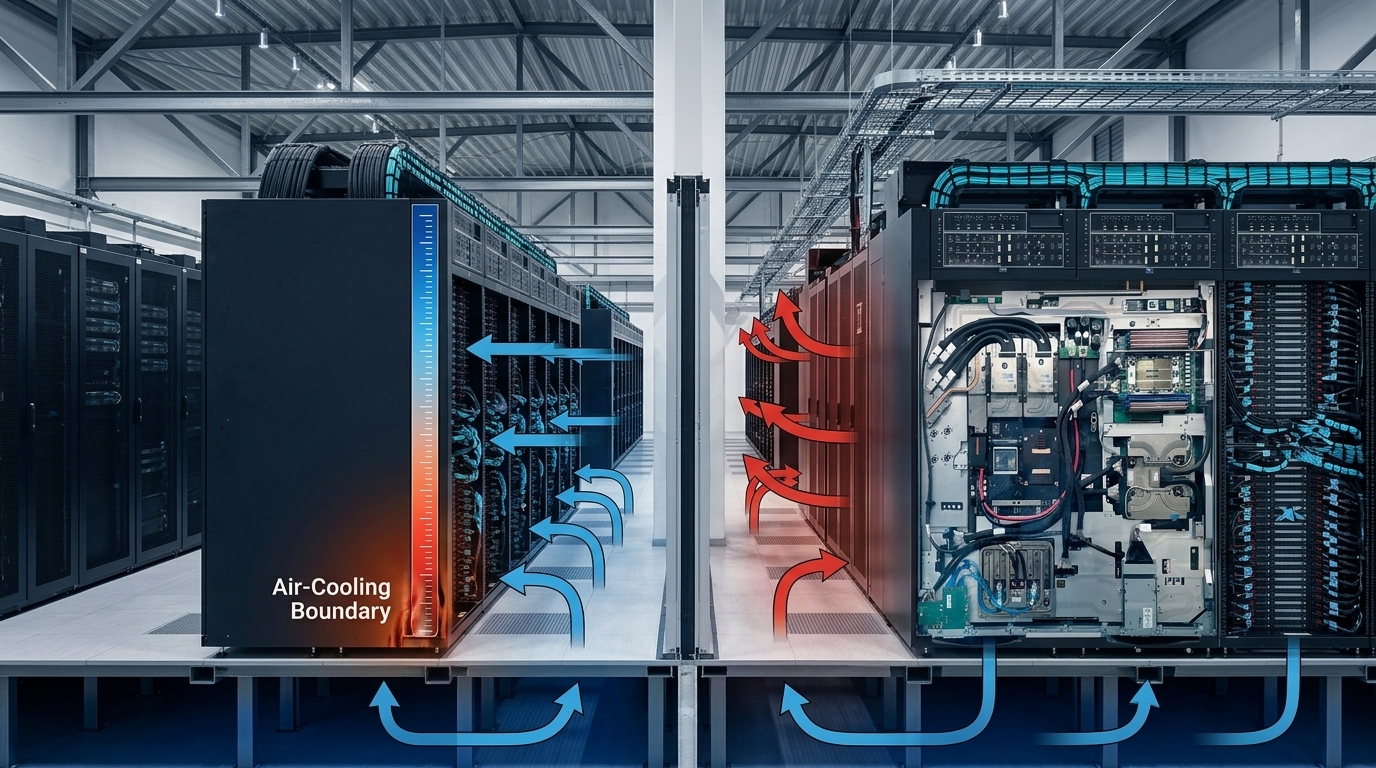
Where air cooling still holds
Air cooling remains the majority technology, but its share is falling on dated survey evidence. A November 2025 S&P Global Market Intelligence 451 Research survey found that only 45% of data centers ran purely on air cooling, down from 48% in 2024, with 59% of operators planning to implement liquid cooling within five years.[1] The driver is density: average rack power density more than doubled in two years, from 8 kW to 17 kW, and is projected to reach 30 kW by 2027, according to an October 2024 McKinsey report.[2]
What air can remove, per rack
- Physics: water's thermal conductivity is roughly 23 times that of air, which is why large air volumes and bigger fans are needed to move the same heat (Upsite, 23 April 2025).[3]
- Energy stake: cooling accounts for up to 40% of data center energy use, per a US Department of Energy estimate (via Network World, March 2026).[4]
- Measurement basis: rack density is stated in kilowatts of IT load per rack; energy efficiency is stated as PUE, total facility energy divided by IT energy, over a stated metering boundary.
One recurring error matters when comparing figures: a site PUE, measured at one facility over one year, is not comparable with a fleet PUE averaged across many facilities and climates. Always check which boundary and which period a published PUE covers before using it. For the density and energy trade-off between the two approaches, see Liquid cooling vs air.
Containment, temperature bands and ASHRAE classes
Effective air cooling means delivering the ASHRAE-recommended temperature and relative humidity of conditioned air at the IT equipment inlets (Upsite, 23 April 2025).[3] ASHRAE publishes the thermal guidelines that data center cooling design follows.[5] The main design lever is air separation: containing cool supply air so it does not mix with hot exhaust remains as important now as it was 30 years ago, and it is what extends air's viability at rising densities.[3]
The rack density where air stops working
| Rack density band | Cooling approach | Published threshold |
|---|---|---|
| Up to ~20 kW per rack | Air cooling | Practical limit of air cooling is ~20 kW per rack; specialized infrastructure and architecture can reach 50 kW (Upsite, 23 April 2025) |
| Up to ~100 kW per rack | Rear-door heat exchangers | RDHx extends air viability to ~100 kW; it still relies on internal server fans (JLL bands, via Network World, 25 March 2026; Data Center Knowledge, 25 August 2026) |
| ~100–175 kW per rack | Direct-to-chip liquid | Fills the middle band where rear-door exchangers fall short; removes roughly 70–90% of a rack's heat at the source (JLL, via Network World, 25 March 2026; Data Center Knowledge, 25 August 2026) |
| Above ~175 kW per rack | Immersion cooling | Immersion is required above ~175 kW (JLL, via Network World, 25 March 2026) |
Current AI hardware already sits in the liquid bands: an Nvidia GB200 NVL72 rack pulls 120 to 130 kW (Network World, March 2026)[7]. For a single-GPU view of the same air-versus-liquid question, see Does the RTX 5090 need liquid cooling.
Choosing air, hybrid or liquid
The choice is a mix, not either-or. Even broadly deployed liquid cooling is always supplemented by air cooling, because heat from circulation equipment and uncooled components still enters the room; Upsite argues hybrid facilities will become the norm (23 April 2025).[3] The table below lists the providers a buyer on this question would compare.
| Provider | Cooling technology stated on its page | Published figure (retrieval date) |
|---|---|---|
| ABB | Not verifiable: the site did not load for the check (30 Sep 2026) | Not verifiable (30 Sep 2026) |
| Asperitas | Immersion cooling: adaptive, modular immersion cooling for high-density compute (read 30 Sep 2026) | – |
| Bloom Energy | – | – |
| Cummins | Not verifiable: the page sat behind a bot check (30 Sep 2026) | Not verifiable (30 Sep 2026) |
| Eaton | Not verifiable: the site did not load for the check (30 Sep 2026) | Not verifiable (30 Sep 2026) |
| Iceotope | Precision liquid cooling at chassis and system level | Vendor's own claim: 40% less power, 84% less cooling usage and 100% less water per kW of IT energy (retrieved 23 September 2026) |
| JetCool | Single-phase direct-to-chip cold plates, coolant distribution units and manifolds | – |
| Legrand | Row-based cooling, chilled-water and direct-expansion coolers, and USystems rear-door cooling (CL20, CL21, CL23) (read 30 Sep 2026) | – |
| Schneider Electric | Liquid cooling: coolant distribution units, heat dissipation units, direct-to-chip accessories and a rear door heat exchanger (read 30 Sep 2026) | – |
| Vertiv | Liquid cooling solutions; its guide covers rear-door heat exchangers, direct-to-chip cold plates, immersion and coolant distribution units (read 30 Sep 2026) | – |
A dash means the provider's own page states no value. The cooling technologies of Asperitas[10], Legrand[11], Schneider Electric[12] and Vertiv[13] were read on 30 September 2026; Bloom Energy's data-center page names on-site power, not a cooling technology.
Two context figures frame the decision. Immersion cooling can reduce cooling energy consumption by up to 90%, per a Schneider Electric estimate cited by Baltimore Aircoil (retrieved September 2026).[14] The Uptime Institute Global Data Center Survey 2025 reports rising costs, worsening power constraints and growing AI density demands.[15] The IEA's Energy and AI report, published 10 April 2025, models data centre electricity demand over the next decade.[16]
- Match the cooling technology to the measured rack density in kilowatts, using the published bands above, not to a vendor category name.
- Ask each provider for the metering boundary and period behind any PUE figure, and whether it is a site or a fleet value.
- Weigh maintenance burden over the system's life, not only installation cost; liquid loops carry fluid and component service intervals (see How long a liquid cooling system lasts).
Sources
Rankings and scores on Optinest cannot be bought — no commercial relationship changes how a provider is assessed. How we score
Related reading
All Energy →Liquid cooling vs air: Rack density and energy overhead
Compare air, direct-to-chip and immersion cooling for data centers. Learn how rack power density, PUE and operational complexity determine the right choice.

Liquid cooling servers: Methods, fluids and density limits
Evaluate whether liquid cooling is right for your servers by comparing rear-door, direct-to-chip and immersion methods against rack-density thresholds.

MongoDB vector database: how Vector Search works, where it stops
MongoDB Vector Search keeps embeddings in the document and queries them with $vectorSearch. Index limits, filters, memory and a recall test, November 2026.
