Is AI required to be supervised
Which AI must have human oversight under the EU AI Act and GDPR, who has to provide it and from when, after the Digital Omnibus moved the dates.
In this article8
- Is AI required to be supervised? The short answer
- What human oversight under Article 14 of the AI Act means
- Who has to supervise: providers and deployers
- When the oversight duty applies after the Digital Omnibus
- What already applies today: GDPR Article 22 and AI literacy
- How to tell whether your AI system is high-risk
- Frequently asked questions
- Sources

Is AI required to be supervised? The short answer
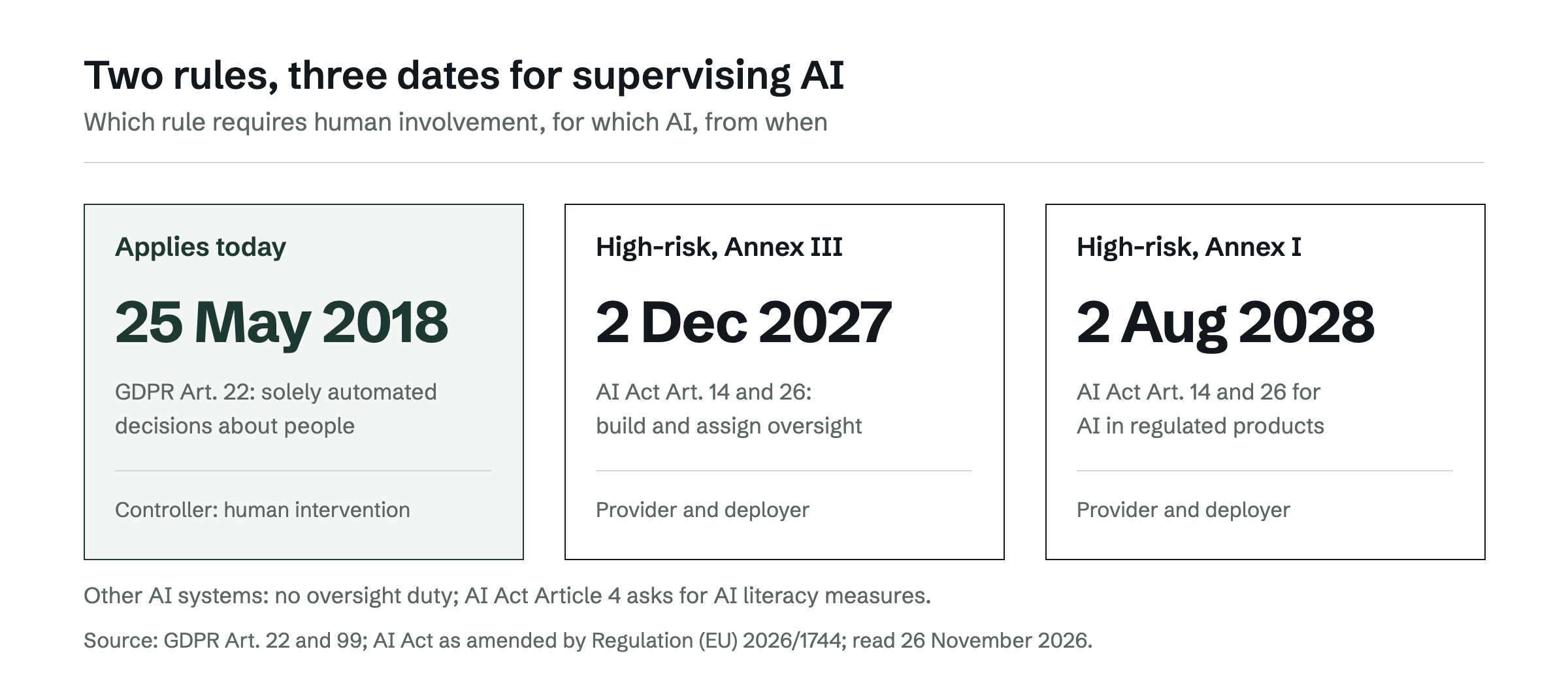
AI is required to be supervised only in defined cases. The EU AI Act sets a human oversight duty for high-risk AI systems. Article 14 obliges providers to design them so natural persons can oversee them effectively.[1] Article 26(2) obliges deployers to assign that oversight to qualified people.[2] A chatbot that drafts emails or a model that summarises documents is not high-risk, so the AI Act sets no oversight duty for it.
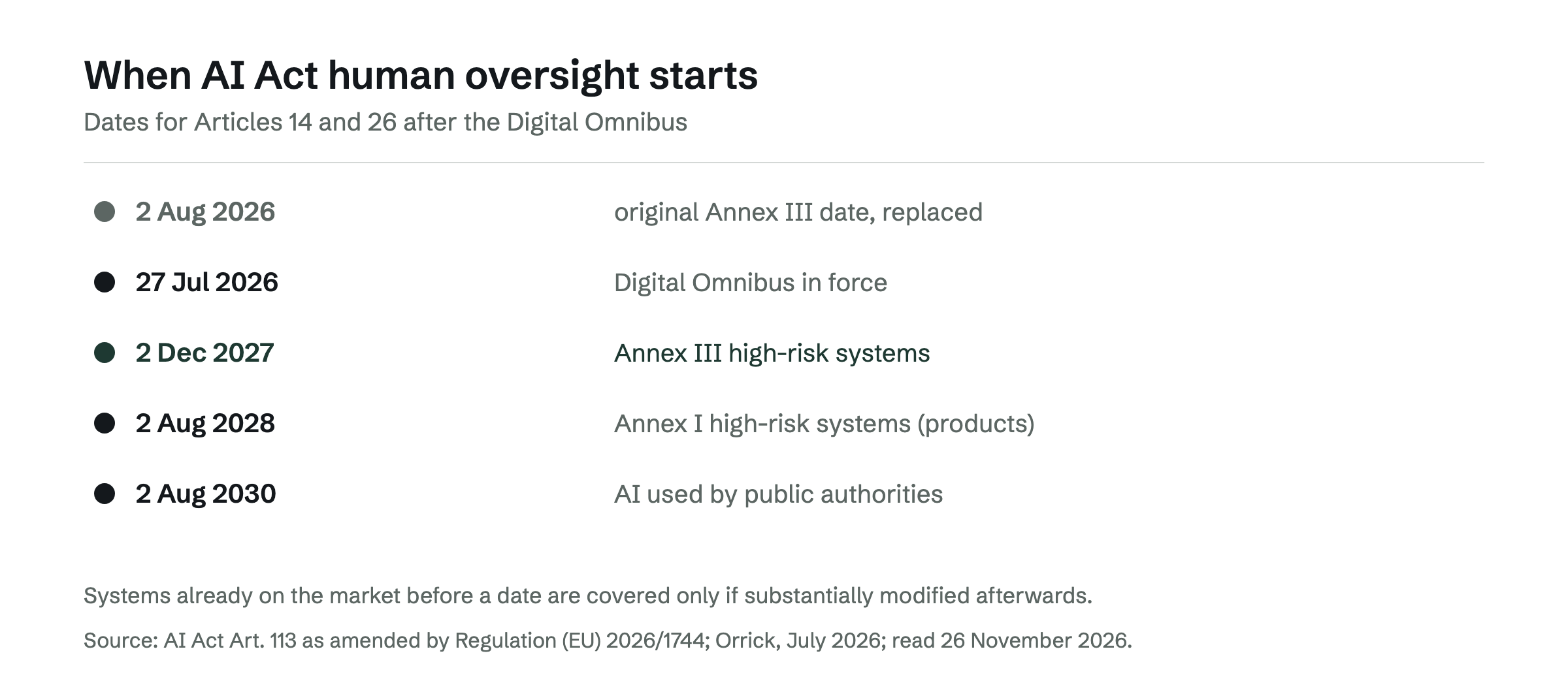
The dates changed in 2026. The Digital Omnibus on AI, Regulation (EU) 2026/1744 of 8 July 2026, entered into force on 27 July 2026 and moved the start of the high-risk rules.[3] The original date of 2 August 2026 no longer applies to them.
One rule already applies. GDPR Article 22 gives a person the right not to be subject to a decision based solely on automated processing that produces legal effects or similarly significantly affects them.[4]
| Rule | Which AI | Who is obliged | Applies from |
|---|---|---|---|
| AI Act Article 14 | High-risk AI systems | Provider: build oversight in | 2 December 2027 (Annex III), 2 August 2028 (Annex I)[3] |
| AI Act Article 26(2) | High-risk AI systems | Deployer: assign competent people | Same dates as Article 14[3] |
| GDPR Article 22 | Any solely automated decision with legal or similarly significant effects | Controller | 25 May 2018[5] |
The recurring error is to quote the old 2 August 2026 date, or the Omnibus as a mere proposal, as the law in force today.
What human oversight under Article 14 of the AI Act means
Human oversight under Article 14 is a design requirement for the system. High-risk AI systems must be built, with appropriate human-machine interface tools, so that natural persons can effectively oversee them while they are in use.[1] The aim is to prevent or minimise risks to health, safety or fundamental rights.
Article 14(4) lists what the people assigned to oversight must be able to do, as appropriate and proportionate.[1]
- Understand the system's capacities and limitations and monitor its operation.
- Remain aware of automation bias, the tendency to rely on an output too readily.
- Interpret the output correctly.
- Decide not to use the system, or disregard, override or reverse its output.
- Intervene in its operation or interrupt it through a "stop" button or a similar procedure that brings it to a halt in a safe state.
For remote biometric identification, listed in Annex III point 1(a), Article 14(5) goes further. No action or decision may rest on an identification unless two competent people have separately verified and confirmed it.[1] The two-person check does not apply to law enforcement, migration, border control or asylum where Union or national law considers it disproportionate.
"Human in the loop" is a design pattern in which a person approves each output. Article 14 does not require that pattern for every decision; it requires that a person can monitor, override and stop the system.
Who has to supervise: providers and deployers
Supervision under the AI Act is split between two roles. The provider is the organisation that develops an AI system, or has it developed, and places it on the market under its own name.[6] The deployer is the organisation that uses the system under its authority in a professional activity.[6] For the full definition, see the AI Act provider definition.
The provider's duty is Article 14: build the interface, the controls and the instructions that make oversight possible. The deployer's duty is Article 26(2): "Deployers shall assign human oversight to natural persons who have the necessary competence, training and authority, as well as the necessary support."[2]
A company that buys a high-risk recruitment tool is a deployer. The vendor supplies the oversight features; the company names the people who use them and gives them the authority to overrule the system. Who needs to comply with the EU AI Act covers how the roles apply to importers and distributors.
When the oversight duty applies after the Digital Omnibus
The oversight duty for high-risk systems applies from 2 December 2027 or 2 August 2028, depending on the type of system. Article 113 of the AI Act, as amended by Regulation (EU) 2026/1744, applies Chapter III, Sections 1 to 3, which hold Articles 14 and 26:[3]
- From 2 December 2027 for AI systems that are high-risk under Article 6(2) and Annex III.
- From 2 August 2028 for AI systems that are high-risk under Article 6(1) and Annex I, which covers AI in products such as machinery and medical devices.
Before the Omnibus, the Annex III date was 2 August 2026. Systems placed on the EU market before the new date fall under the requirements only if they are substantially modified after it. AI systems intended for use by public authorities must comply by 2 August 2030.[7]
The Omnibus postpones the oversight duty; it does not rewrite Article 14. The updated AI Act deadline timeline lists the other dates.
What already applies today: GDPR Article 22 and AI literacy
Two duties already apply in November 2026. The first is GDPR Article 22. A person has the right not to be subject to a decision based solely on automated processing, including profiling, that produces legal effects or similarly significantly affects them.[4] Such a decision is allowed only in the cases Article 22(2) names, such as a contract or explicit consent. In those cases the controller must offer safeguards. They include at least "the right to obtain human intervention on the part of the controller", to state a point of view and to contest the decision.[4]
Article 22 covers only decisions about people made without human involvement, but it covers them whatever the technology.
The second duty is AI literacy under Article 4 of the AI Act, as amended by the Omnibus. Providers and deployers "shall take measures to support the development of AI literacy of their staff". The obligation does not require them to guarantee any specific level of AI literacy.[3] AI literacy is training, not supervision, but it is the duty that reaches every AI system in a company.
How to tell whether your AI system is high-risk
An AI system is high-risk under Annex III when it is used in one of eight areas:[8]
| Area in Annex III | Example of a listed use |
|---|---|
| Biometrics | Remote biometric identification |
| Critical infrastructure | Safety components in the management of critical digital infrastructure, road traffic or utilities |
| Education and vocational training | Admission to institutions and evaluation of learning outcomes |
| Employment and workers' management | Recruitment, selection, promotion and termination decisions |
| Access to essential private and public services | Creditworthiness assessment and credit scoring, except fraud detection |
| Law enforcement | Evaluating the reliability of evidence or the risk of a person offending |
| Migration, asylum and border control | Examining applications for asylum, visas and residence permits |
| Administration of justice and democratic processes | Assisting a judicial authority in researching and interpreting facts and the law |
The second route is Annex I. It covers an AI system that is a safety component of a product, or a product itself, under EU harmonisation legislation. The product must also need a third-party conformity assessment.[9]
A missed oversight duty is an operator breach. Article 99(4) sets fines of up to EUR 15,000,000 for it. For an undertaking the ceiling is 3% of worldwide annual turnover if that is higher.[10] AI Act enforcement: who fines whom explains which authority acts.
A short check for each system in use:
- Does it make, or prepare, a decision about a person without a human in between? Then GDPR Article 22 applies today.
- Is its use listed in one of the eight Annex III areas, or is it a safety component under Annex I? Then Articles 14 and 26 apply from 2 December 2027 or 2 August 2028.
- If neither, the AI Act sets no oversight duty, and Article 4 asks only for AI literacy measures.
Last verified: 26 November 2026. Next scheduled review: 26 February 2027.
Frequently asked questions
Does ChatGPT or a chatbot at work need human oversight under the AI Act?
Not as such. The human oversight duties in Articles 14 and 26 apply to high-risk AI systems. A general chatbot used for drafting or research is not listed in Annex III. If it is used to decide on recruitment, credit or another Annex III use, that use becomes high-risk.
What is the difference between human in the loop and human oversight?
Human in the loop means a person approves each output before it takes effect. Human oversight under Article 14 means the people assigned can understand, monitor, override and stop the system. The AI Act requires the second; it does not require a person to approve every output.
Does the AI Act require two people to check every AI decision?
No. The two-person check in Article 14(5) applies to remote biometric identification under Annex III point 1(a). No action may be taken on an identification unless two competent people have separately verified and confirmed it, with exceptions for law enforcement, migration, border control and asylum.
What changed for human oversight with the Digital Omnibus?
The dates. Regulation (EU) 2026/1744 moved the start of Articles 14 and 26 from 2 August 2026 to 2 December 2027 for Annex III systems. Annex I systems follow on 2 August 2028. The oversight requirements themselves were not rewritten.
The dates above are the ones in force on 26 November 2026. For every other AI Act milestone, read the updated deadline timeline on Optinest.
Sources
Rankings and scores on Optinest cannot be bought — no commercial relationship changes how a provider is assessed. How we score
Related reading
All Regulation →AI Act enforcement: who fines whom, how much and from when
Who enforces the EU AI Act, the four fine tiers from EUR 7.5 million to EUR 35 million, and which dates apply after Regulation (EU) 2026/1744.

What an AI vendor's DPA must put in writing
What a DPA for AI vendors must contain under GDPR Article 28, how ten European providers differ, and which claims a contract cannot back.

What companies are banning AI in USA
Which US companies and governments ban AI tools, what each ban covers and since when: from the 2023 ChatGPT restrictions to the 2026 DeepSeek order.
